What Is Web3? Understanding the Next Generation of the Internet
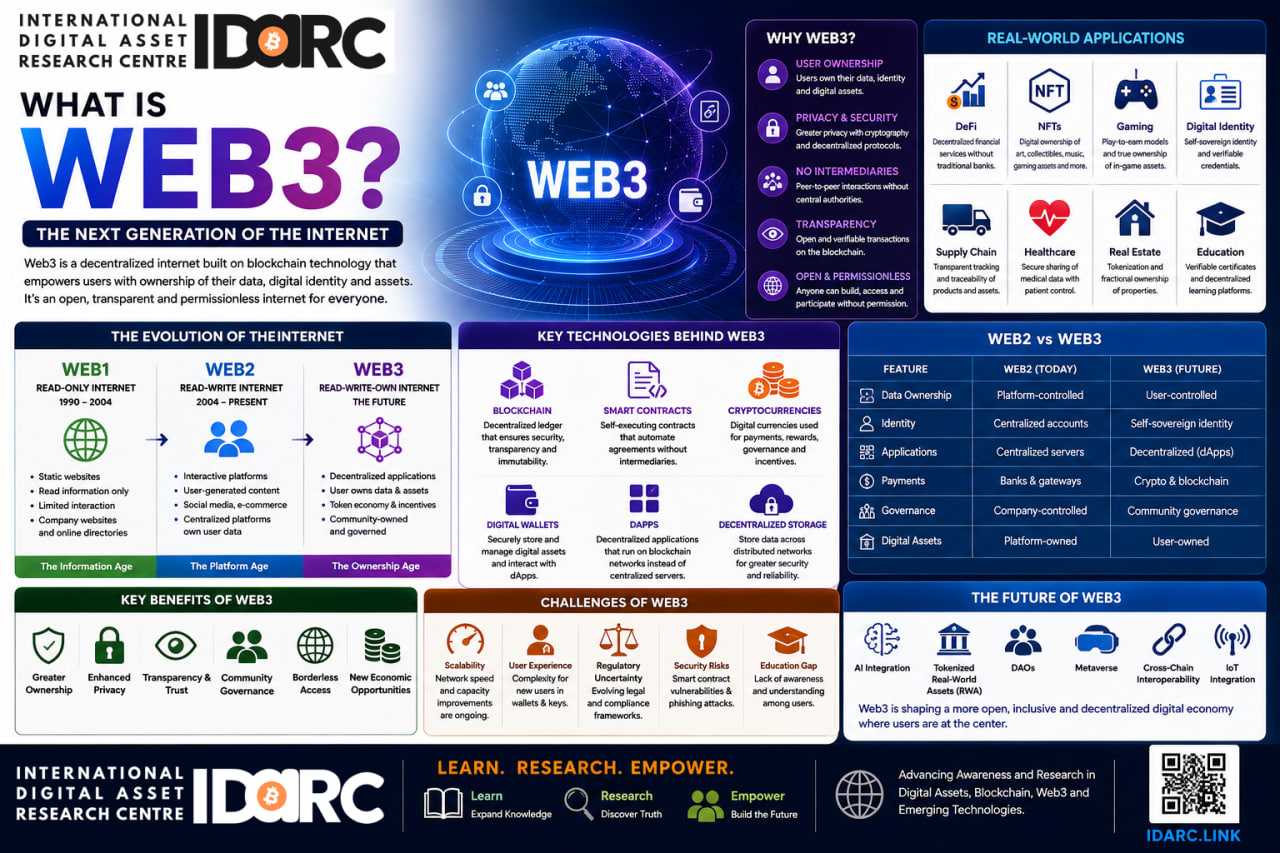
What Is Web3? Understanding the Next Generation of the Internet
Published by the International Digital Asset Research Centre (IDARC)
Introduction
The internet has transformed nearly every aspect of modern life, from communication and commerce to education and entertainment. Over the past three decades, it has evolved through different stages, each introducing new technologies and changing how people interact with the digital world.
Today, a new phase of internet evolution is emerging—Web3. Built on blockchain technology, Web3 aims to create a more decentralized, transparent, and user-centric internet where individuals have greater control over their data, digital identity, and digital assets.
Unlike today’s internet, where large technology companies often control platforms and user information, Web3 seeks to distribute power across decentralized networks, enabling users to participate directly without relying on centralized intermediaries.
This article explains Web3 in simple language, explores how it differs from earlier versions of the internet, and examines why it is considered the foundation of the future digital economy.
What Is Web3?
Web3 is the next generation of the internet that uses blockchain technology, decentralized networks, and smart contracts to enable users to own their digital identities, assets, and data.
Instead of depending on centralized platforms to manage information and digital services, Web3 allows applications to operate across decentralized blockchain networks where ownership and governance are shared among participants.
Simply put,
Web3 is a decentralized internet that gives users greater ownership, privacy, transparency, and control over their digital lives.
The Evolution of the Internet
Understanding Web3 becomes easier when viewed alongside earlier stages of internet development.
Web1 – The Read-Only Internet (1990–2004)
The first generation of the internet focused primarily on accessing information.
Users could:
- Read websites
- Browse static web pages
- Search for information
- Access online directories
Most websites were static, and interaction was minimal.
Examples included:
- Personal websites
- News portals
- Company websites
- Online directories
Web2 – The Read-Write Internet (2004–Present)
Web2 introduced user-generated content and interactive platforms.
People could:
- Create social media profiles
- Upload videos
- Share photographs
- Publish blogs
- Shop online
- Use cloud-based applications
Major Web2 platforms include:
- Social media networks
- Video-sharing platforms
- E-commerce marketplaces
- Online collaboration tools
Although Web2 transformed communication and business, most user data became concentrated within a relatively small number of large technology companies.
Web3 – The Read-Write-Own Internet
Web3 adds ownership to the internet experience.
Users can now:
- Own digital assets
- Control digital identities
- Participate in decentralized governance
- Interact directly through blockchain networks
- Transfer value without intermediaries
- Earn rewards for contributing to ecosystems
Instead of platforms owning user data, individuals gain greater control over their information and digital property.
Why Was Web3 Created?
Web3 was developed to address several limitations associated with today’s internet.
Greater User Ownership
Users should own their digital identities, content, and assets rather than surrendering control to centralized platforms.
Improved Privacy
Individuals should decide how their personal information is collected, stored, and shared.
Reduced Dependence on Intermediaries
Many online services currently require centralized organizations to process transactions and manage data.
Web3 enables direct peer-to-peer interaction.
Increased Transparency
Blockchain technology provides publicly verifiable transaction records that improve trust and accountability.
Open Participation
Anyone with an internet connection can participate in many Web3 applications without requiring approval from centralized authorities.
Core Technologies Behind Web3
Several technologies work together to power Web3.
Blockchain
Blockchain provides secure, decentralized recordkeeping.
It serves as the foundation for ownership, transactions, and digital trust.
Smart Contracts
Smart contracts automatically execute agreements according to predefined rules without requiring intermediaries.
Cryptocurrencies
Digital currencies facilitate payments, rewards, governance, and network participation.
Digital Wallets
Wallets allow users to securely manage digital assets, identities, and blockchain interactions.
Decentralized Applications (dApps)
Applications operate directly on blockchain networks instead of centralized servers.
Decentralized Storage
Files and digital content can be distributed across decentralized storage networks, reducing dependence on centralized cloud providers.
Key Characteristics of Web3
Decentralization
Applications operate across distributed networks rather than centralized servers.
Digital Ownership
Users own digital assets such as cryptocurrencies, NFTs, and tokenized property.
Transparency
Blockchain records are publicly verifiable while maintaining cryptographic security.
Permissionless Access
Anyone can participate without requiring approval from centralized organizations.
Interoperability
Many Web3 applications are designed to interact across different blockchain ecosystems.
Community Governance
Many projects allow token holders to participate in governance and decision-making through decentralized voting mechanisms.
Real-World Applications of Web3
Web3 is creating new opportunities across multiple industries.
Decentralized Finance (DeFi)
Financial services including lending, borrowing, trading, and asset management without traditional financial intermediaries.
Non-Fungible Tokens (NFTs)
Digital ownership of artwork, collectibles, music, gaming assets, and intellectual property.
Gaming
Players can own in-game assets and trade them across compatible platforms.
Digital Identity
Individuals manage their own identity credentials without relying on centralized databases.
Supply Chain Management
Blockchain improves transparency and product traceability.
Healthcare
Secure sharing of medical records while maintaining patient control over personal information.
Education
Blockchain-based certificates and academic credentials that are instantly verifiable.
Real Estate
Property tokenization and fractional ownership through blockchain networks.
Benefits of Web3
Web3 offers several advantages over traditional internet models.
- Greater user ownership
- Enhanced privacy
- Improved transparency
- Increased security
- Reduced dependence on intermediaries
- Borderless participation
- Faster value transfer
- Digital asset ownership
- Community-driven governance
- New economic opportunities
Challenges of Web3
Despite its potential, Web3 also faces several challenges.
Scalability
Some blockchain networks continue to improve transaction speed and capacity.
User Experience
Managing wallets, private keys, and blockchain transactions can be challenging for beginners.
Regulatory Uncertainty
Legal frameworks for Web3 technologies continue to evolve across different countries.
Security Risks
Poorly designed smart contracts, phishing attacks, and wallet security remain important concerns.
Education Gap
Many users are unfamiliar with blockchain technology and decentralized systems.
Web2 vs Web3
| Feature | Web2 | Web3 |
|---|---|---|
| Data Ownership | Platform-controlled | User-controlled |
| Identity | Centralized accounts | Self-sovereign identity |
| Payments | Banks and payment gateways | Cryptocurrencies and blockchain |
| Applications | Centralized servers | Decentralized applications (dApps) |
| Governance | Company controlled | Community participation |
| Digital Assets | Platform-owned | User-owned |
Common Misconceptions
Web3 Is Only Cryptocurrency
Cryptocurrencies are one part of Web3.
Web3 also includes decentralized applications, digital identities, NFTs, DAOs, decentralized storage, and blockchain infrastructure.
Web3 Will Replace the Entire Internet
Web3 is expected to complement and gradually integrate with existing internet technologies rather than replacing them entirely.
Web3 Is Completely Anonymous
Most blockchain networks are pseudonymous.
Transactions remain publicly visible while users are represented by cryptographic wallet addresses.
The Future of Web3
Web3 continues to evolve rapidly.
Emerging developments include:
- Artificial Intelligence integration
- Tokenized Real-World Assets (RWAs)
- Decentralized Identity (DID)
- Decentralized Autonomous Organizations (DAOs)
- Blockchain gaming
- Metaverse ecosystems
- Cross-chain interoperability
- Enterprise blockchain adoption
- Internet of Things (IoT) integration
As governments, businesses, developers, and research institutions continue exploring decentralized technologies, Web3 is expected to become an increasingly important component of the global digital economy.
Conclusion
Web3 represents a significant evolution in how the internet operates by shifting ownership, control, and participation from centralized platforms to users and decentralized networks.
By combining blockchain technology, smart contracts, cryptocurrencies, decentralized applications, and digital identity, Web3 introduces new possibilities for innovation, transparency, collaboration, and digital ownership.
Although the technology is still evolving, Web3 is already influencing finance, commerce, education, entertainment, healthcare, and governance. Understanding its principles today provides a strong foundation for participating in the next generation of the internet and the broader digital asset ecosystem.
Key Takeaways
- Web3 is the next generation of the internet built on decentralized technologies.
- It enables users to own digital assets, identities, and data.
- Blockchain and smart contracts form the foundation of Web3.
- Web3 supports decentralized applications, digital wallets, and peer-to-peer interactions.
- The technology promotes transparency, security, and community governance.
- Web3 is expected to play a major role in the future digital economy.
About the International Digital Asset Research Centre (IDARC)
The International Digital Asset Research Centre (IDARC) is an independent research and educational institution dedicated to advancing awareness, education, and evidence-based research in digital assets, blockchain technology, Web3, decentralized finance, tokenization, cybersecurity, and emerging digital ecosystems.
Through research publications, whitepaper analysis, educational initiatives, policy dialogue, and public awareness programs, IDARC empowers researchers, professionals, legal practitioners, businesses, policymakers, and the public with trusted knowledge that supports informed participation in the rapidly evolving digital economy.
Motto: Learn. Research. Empower.
Website: https://IDARC.Link
0 Comments