What Is Tokenization? Understanding the Future of Digital Ownership
What Is Tokenization? Understanding the Future of Digital Ownership
Published by the International Digital Asset Research Centre (IDARC)
Introduction
As blockchain technology continues to transform the global economy, tokenization has emerged as one of its most revolutionary applications. While cryptocurrencies introduced the concept of digital money, tokenization extends blockchain technology to represent virtually any type of asset in digital form.
From real estate and artwork to company shares, commodities, intellectual property, and even carbon credits, tokenization is enabling assets to be digitally represented, securely managed, and efficiently transferred across blockchain networks.
Governments, financial institutions, technology companies, and investment firms worldwide are increasingly exploring tokenization as a means to improve transparency, accessibility, liquidity, and operational efficiency.
This article explains tokenization in simple language, examines how it works, explores its benefits and challenges, and highlights why it is expected to become a cornerstone of the future digital economy.
What Is Tokenization?
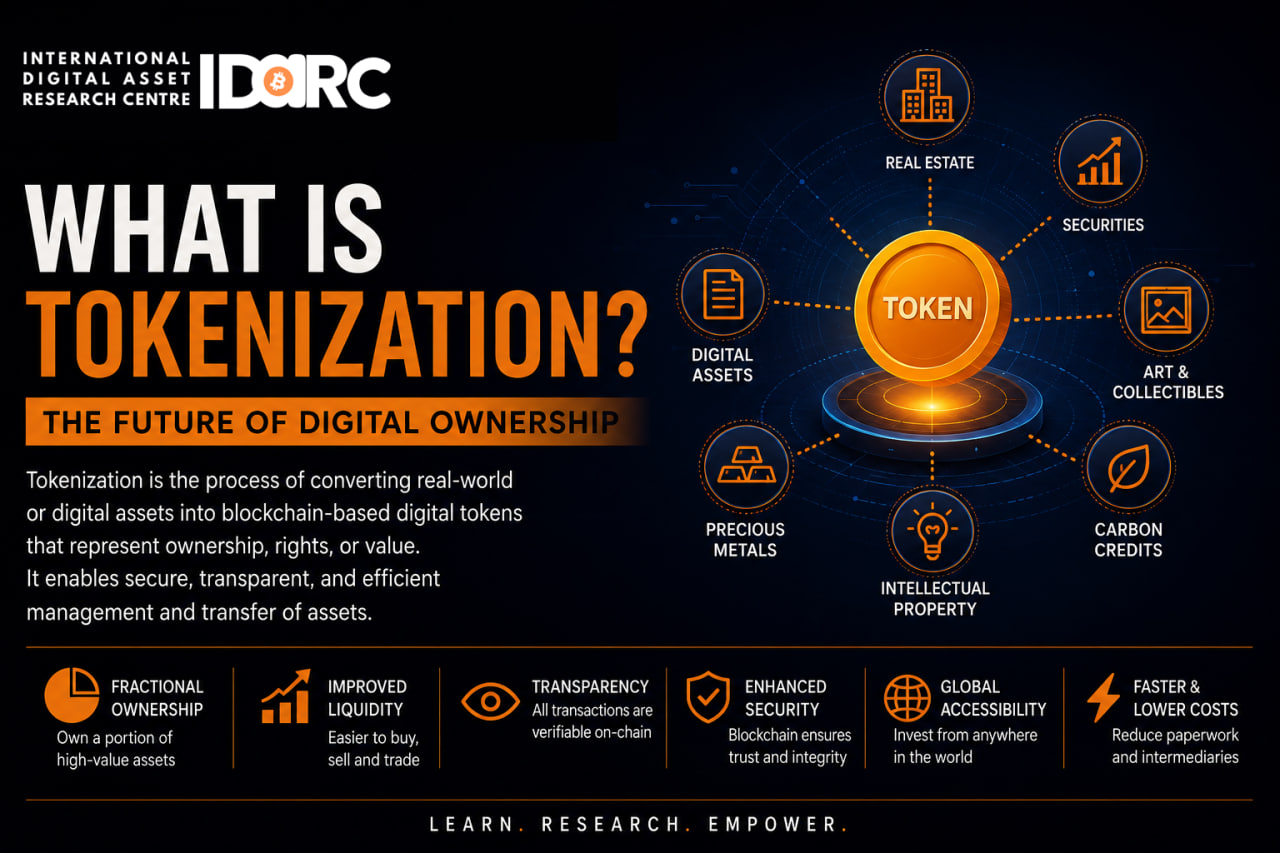
Tokenization is the process of converting the ownership or rights of a physical or digital asset into a digital token that exists on a blockchain.
Each token represents a specific ownership interest, right, or value associated with an underlying asset.
Instead of transferring the physical asset itself, ownership can be transferred by securely exchanging its digital token.
Simply put,
Tokenization is the process of representing real-world or digital assets as blockchain-based digital tokens.
What Is a Token?
A token is a digital representation of value, ownership, rights, or access that exists on a blockchain.
Unlike cryptocurrencies that primarily function as digital money, tokens can represent many different types of assets and utilities.
Examples include:
- Property ownership
- Company shares
- Gold
- Artwork
- Music rights
- Loyalty points
- Event tickets
- Digital collectibles
- Carbon credits
- Intellectual property
Why Was Tokenization Created?
Tokenization addresses several limitations associated with traditional asset ownership and transfer.
Improve Liquidity
High-value assets can be divided into smaller digital units, making them easier to buy, sell, and trade.
Fractional Ownership
Multiple investors can own portions of valuable assets such as commercial buildings or fine art.
Faster Transactions
Blockchain technology reduces settlement times by enabling direct peer-to-peer transfers.
Greater Transparency
Ownership records are securely recorded on blockchain networks where transactions can be independently verified.
Reduced Costs
Tokenization minimizes paperwork and reduces reliance on multiple intermediaries.
Global Accessibility
Investors from different countries can participate in tokenized asset markets, subject to applicable laws and regulations.
How Does Tokenization Work?
Although the technology is sophisticated, the process can be understood in a few simple steps.
Step 1: Asset Identification
An asset suitable for tokenization is identified.
Examples include:
- Real estate
- Gold
- Artwork
- Stocks
- Bonds
- Intellectual property
Step 2: Asset Valuation
The asset is professionally valued and ownership details are verified.
Step 3: Token Creation
Digital tokens representing ownership or rights are created on a blockchain.
Step 4: Smart Contract Deployment
Smart contracts define the rules governing ownership, transfer, compliance, and other conditions.
Step 5: Distribution
The digital tokens are issued to eligible investors or owners.
Step 6: Trading and Management
Token holders can transfer, trade, or manage their ownership according to applicable regulations and platform rules.
Types of Tokenization
Tokenization can apply to a wide variety of assets.
Real Estate Tokenization
Properties are divided into digital ownership units, enabling fractional investment.
Precious Metals
Gold, silver, and other commodities can be represented through blockchain-based tokens.
Securities Tokenization
Shares, bonds, and investment products can be digitally represented while complying with securities regulations.
Intellectual Property
Patents, copyrights, music royalties, and trademarks can be tokenized to simplify ownership management and revenue distribution.
Art and Collectibles
Paintings, sculptures, rare collectibles, and luxury goods can be tokenized for fractional ownership.
Carbon Credits
Environmental assets can be tokenized to improve transparency and facilitate sustainable trading.
Digital Assets
Native blockchain assets, gaming assets, NFTs, and virtual goods may also be represented through tokens.
Real-World Applications
Tokenization is transforming numerous industries.
Financial Services
- Digital securities
- Investment products
- Cross-border settlements
Real Estate
- Fractional ownership
- Global investment opportunities
- Simplified property transfers
Supply Chain
- Product authentication
- Ownership tracking
- Anti-counterfeiting
Healthcare
- Secure patient records
- Medical data management
Intellectual Property
- Royalty distribution
- Licensing
- Digital rights management
Entertainment
- Music ownership
- Film financing
- Digital collectibles
- Fan engagement
Agriculture
- Commodity trading
- Farm ownership structures
- Carbon credit markets
Benefits of Tokenization
Tokenization offers several significant advantages.
Fractional Ownership
Investors can purchase smaller portions of high-value assets.
Improved Liquidity
Previously illiquid assets become easier to trade.
Increased Transparency
Blockchain provides verifiable ownership records.
Enhanced Security
Cryptographic protection secures ownership and transactions.
Faster Settlement
Transactions can often be completed more efficiently than traditional processes.
Lower Costs
Automation reduces administrative expenses and intermediary involvement.
Global Investment Access
Digital platforms enable broader participation in investment opportunities.
Programmable Assets
Smart contracts can automate dividend payments, royalties, compliance checks, and ownership transfers.
Tokenization vs Traditional Ownership
| Feature | Traditional Assets | Tokenized Assets |
|---|---|---|
| Ownership Records | Paper or centralized databases | Blockchain |
| Settlement | Days | Potentially minutes or hours |
| Accessibility | Often geographically limited | Global participation |
| Fractional Ownership | Limited | Easily supported |
| Transparency | Limited | High |
| Transfer Process | Manual | Digital |
Challenges of Tokenization
Although tokenization presents tremendous opportunities, several challenges remain.
Regulatory Compliance
Legal frameworks continue to evolve across jurisdictions.
Technology Adoption
Organizations must modernize infrastructure to support blockchain integration.
Cybersecurity
Wallet security and private key management remain critical.
Market Education
Many investors are unfamiliar with blockchain-based ownership models.
Interoperability
Different blockchain networks may require greater compatibility for seamless asset transfers.
Tokenization and Smart Contracts
Smart contracts play a critical role in tokenization.
They automate processes such as:
- Ownership transfer
- Dividend distribution
- Royalty payments
- Compliance verification
- Voting rights
- Investment management
Automation reduces human intervention while improving efficiency and transparency.
Tokenization vs NFTs
Although both involve blockchain-based tokens, they serve different purposes.
| Tokenization | NFTs |
|---|---|
| Represents divisible ownership | Represents unique ownership |
| Often supports fractional ownership | Usually represents a single unique asset |
| Used for investments and asset management | Used for collectibles, art, gaming, and digital ownership |
| May represent real-world assets | Primarily represents unique digital or physical items |
Common Misconceptions
Tokenization Is Only for Cryptocurrency
Tokenization applies to many asset classes, including real estate, securities, commodities, intellectual property, and infrastructure.
Tokenization Eliminates Legal Requirements
Blockchain technology does not replace applicable legal and regulatory obligations.
Ownership rights, securities laws, taxation, and compliance requirements continue to apply.
Only Large Institutions Can Benefit
Tokenization also creates opportunities for small investors by enabling fractional ownership of previously inaccessible assets.
The Future of Tokenization
Many experts consider tokenization one of the most significant developments in financial markets.
Emerging trends include:
- Tokenized Real-World Assets (RWAs)
- Central Bank Digital Currencies (CBDCs)
- Digital securities
- Institutional blockchain adoption
- Cross-border asset trading
- AI-integrated financial infrastructure
- Decentralized Finance (DeFi)
- Digital identity integration
Industry analysts estimate that trillions of dollars in assets may eventually be represented on blockchain networks as tokenization continues to mature.
Conclusion
Tokenization represents a fundamental shift in how ownership is created, managed, and transferred in the digital age. By converting physical and digital assets into blockchain-based tokens, it improves accessibility, transparency, efficiency, and liquidity while opening new opportunities for businesses and investors worldwide.
As blockchain adoption accelerates, tokenization is expected to play an increasingly important role across finance, real estate, healthcare, intellectual property, entertainment, and many other sectors.
Understanding tokenization today provides valuable insight into the future of digital ownership and the rapidly evolving digital asset ecosystem.
Key Takeaways
- Tokenization converts physical or digital assets into blockchain-based digital tokens.
- Tokens can represent ownership, rights, or value associated with an underlying asset.
- Tokenization enables fractional ownership and improved liquidity.
- Smart contracts automate ownership management and asset transfers.
- Tokenization is transforming finance, real estate, healthcare, entertainment, and many other industries.
- It is expected to become a foundational component of the future digital economy.
About the International Digital Asset Research Centre (IDARC)
The International Digital Asset Research Centre (IDARC) is an independent research and educational institution dedicated to advancing awareness, education, and evidence-based research in digital assets, blockchain technology, Web3, decentralized finance, tokenization, cybersecurity, and emerging digital ecosystems.
Through research publications, whitepaper analysis, educational initiatives, policy dialogue, and public awareness programs, IDARC empowers researchers, professionals, legal practitioners, businesses, policymakers, and the public with trusted knowledge that supports informed participation in the rapidly evolving digital economy.
Motto: Learn. Research. Empower.
Website: https://IDARC.Link
0 Comments