Understanding Ethereum and Smart Contracts
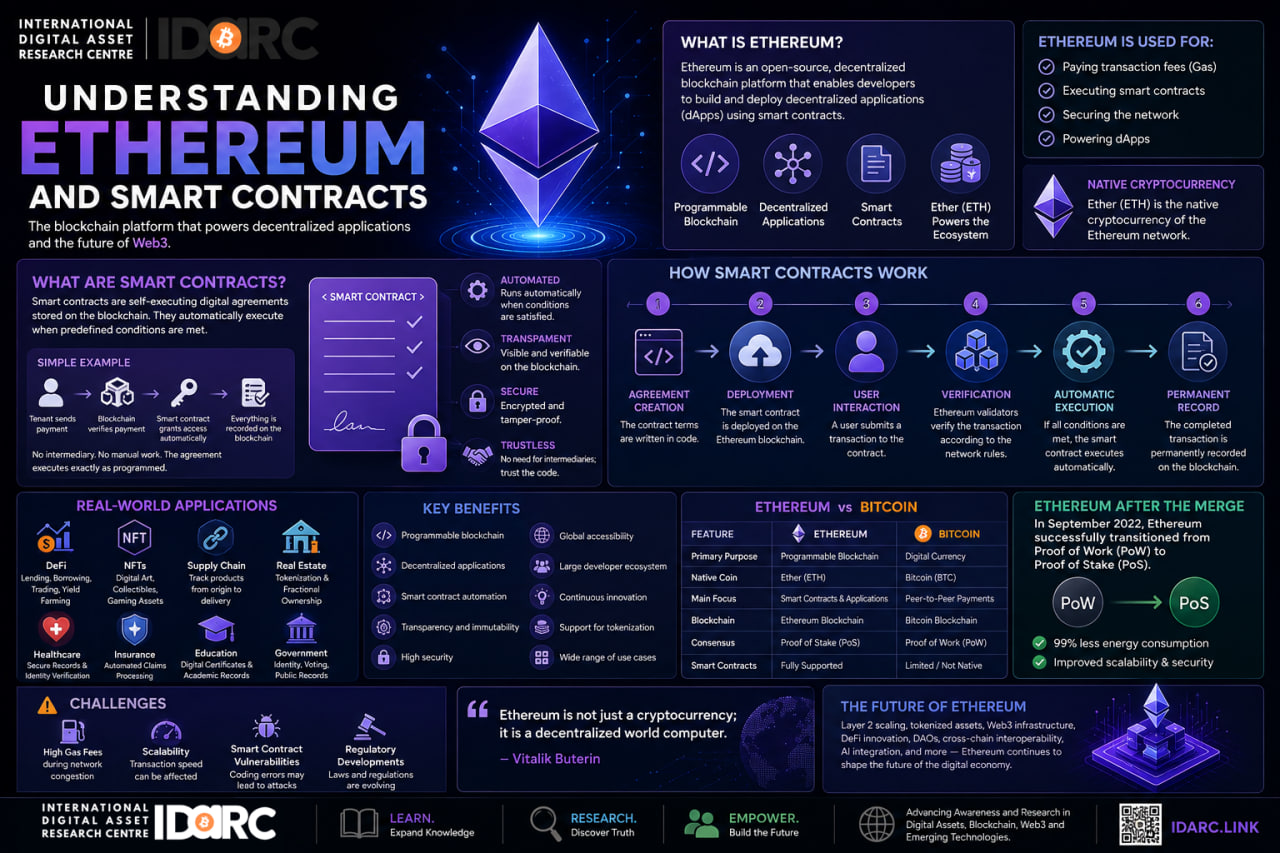
Understanding Ethereum and Smart Contracts
Published by the International Digital Asset Research Centre (IDARC)
Introduction
Since the launch of Bitcoin in 2009, blockchain technology has evolved significantly. While Bitcoin introduced the world to decentralized digital money, Ethereum expanded the possibilities of blockchain by enabling developers to build decentralized applications and automate digital agreements through smart contracts.
Today, Ethereum is one of the world’s most influential blockchain platforms, supporting thousands of decentralized applications (dApps), decentralized finance (DeFi) protocols, Non-Fungible Tokens (NFTs), gaming ecosystems, decentralized autonomous organizations (DAOs), and tokenized digital assets.
Understanding Ethereum and smart contracts is essential for anyone exploring blockchain technology, Web3, digital assets, or the future of the digital economy.
This article explains Ethereum and smart contracts in simple language, helping beginners understand how they work and why they are transforming industries worldwide.
What is Ethereum?
Ethereum is an open-source, decentralized blockchain platform that enables developers to build and deploy decentralized applications (dApps) using programmable smart contracts.
Unlike Bitcoin, which was primarily designed as a decentralized digital currency, Ethereum was created as a programmable blockchain capable of supporting a wide variety of applications beyond financial transactions.
Ethereum introduced the concept of a “world computer,” where applications can run securely without relying on centralized servers or intermediaries.
Its native cryptocurrency is called Ether (ETH), which is used to pay transaction fees, execute smart contracts, and secure the network.
Simply put,
Ethereum is a decentralized blockchain platform that allows developers to create secure, programmable applications powered by smart contracts.
Who Created Ethereum?
Ethereum was proposed in 2013 by Vitalik Buterin, a software developer and blockchain researcher.
Recognizing the limitations of Bitcoin’s scripting capabilities, Vitalik envisioned a blockchain platform that could execute programmable logic, enabling developers to build applications directly on the blockchain.
Ethereum officially launched on 30 July 2015, marking the beginning of programmable blockchain technology.
Since then, it has become one of the largest blockchain ecosystems in the world.
Why Was Ethereum Created?
Ethereum was designed to expand blockchain technology beyond digital payments.
Its primary objectives included:
Programmable Blockchain
Allow developers to build decentralized applications without creating an entirely new blockchain.
Smart Contracts
Enable agreements to execute automatically when predefined conditions are satisfied.
Decentralized Applications
Support applications that operate without centralized control.
Token Creation
Allow organizations to create digital tokens representing assets, memberships, utilities, or investments.
Innovation
Provide a platform where developers worldwide can build financial services, marketplaces, games, identity systems, and enterprise solutions.
What is Ether (ETH)?
Ether (ETH) is Ethereum’s native cryptocurrency.
It serves several important purposes.
- Pays transaction fees (Gas Fees)
- Executes smart contracts
- Rewards network validators
- Supports decentralized applications
- Facilitates value transfer across the Ethereum network
Unlike Bitcoin, whose primary purpose is digital money, Ether also functions as the fuel that powers the Ethereum ecosystem.
What are Smart Contracts?
A smart contract is a self-executing digital agreement stored on a blockchain.
The terms and conditions of the agreement are written as computer code.
When predefined conditions are met, the contract automatically performs the agreed action without requiring manual intervention.
Simply put,
A smart contract is a digital agreement that automatically executes when specific conditions are fulfilled.
Understanding Smart Contracts Through a Simple Example
Imagine renting an apartment.
Traditionally, the landlord verifies payment before handing over the keys.
With a smart contract:
- The tenant sends payment.
- The blockchain verifies the payment.
- The smart contract automatically grants digital access.
- No intermediary is required.
- Every step is recorded transparently.
The agreement executes exactly as programmed.
How Do Smart Contracts Work?
Although powered by advanced blockchain technology, the workflow is straightforward.
Step 1: Agreement Creation
The contract terms are written in code.
Step 2: Deployment
The smart contract is deployed on the Ethereum blockchain.
Step 3: User Interaction
A user submits a transaction to the contract.
Step 4: Verification
Ethereum validators verify the transaction.
Step 5: Automatic Execution
If all conditions are satisfied, the smart contract executes automatically.
Step 6: Permanent Recording
The completed transaction becomes part of Ethereum’s immutable blockchain.
Key Characteristics of Smart Contracts
Automation
No manual intervention is required after deployment.
Transparency
Contract code and transaction history can often be independently verified.
Security
Cryptographic security protects contract execution.
Immutability
Once deployed, contract logic is generally difficult to alter without following predefined upgrade mechanisms.
Trust Minimization
Participants rely on transparent code rather than intermediaries.
Real-World Applications of Ethereum
Ethereum powers applications across numerous industries.
Decentralized Finance (DeFi)
- Lending
- Borrowing
- Trading
- Yield generation
- Stablecoins
Non-Fungible Tokens (NFTs)
- Digital artwork
- Music
- Collectibles
- Gaming assets
- Event tickets
Supply Chain Management
Track products from manufacturing to delivery.
Healthcare
Secure medical records and identity verification.
Real Estate
Property tokenization and fractional ownership.
Insurance
Automated claims processing through smart contracts.
Education
Blockchain-based certificates and academic credentials.
Government
Digital identity systems, public records, and document verification.
Advantages of Ethereum
Ethereum offers numerous benefits.
- Programmable blockchain
- Decentralized applications
- Global accessibility
- Smart contract automation
- Transparency
- High security
- Developer-friendly ecosystem
- Large global community
- Continuous innovation
- Support for tokenization
Challenges of Ethereum
Like every technology, Ethereum also has limitations.
Gas Fees
Transaction costs can become expensive during periods of high network activity.
Scalability
Heavy usage may increase processing times, although ongoing upgrades and Layer 2 solutions continue to improve scalability.
Smart Contract Vulnerabilities
Poorly written smart contracts may contain coding errors that attackers can exploit.
Regulatory Developments
Legal frameworks surrounding blockchain applications continue to evolve across different jurisdictions.
Ethereum After “The Merge”
One of Ethereum’s most significant milestones was The Merge, completed in September 2022.
The network transitioned from the energy-intensive Proof of Work (PoW) consensus mechanism to the more energy-efficient Proof of Stake (PoS).
This change significantly reduced Ethereum’s energy consumption while laying the foundation for future scalability improvements.
Bitcoin vs Ethereum
| Feature | Bitcoin | Ethereum |
|---|---|---|
| Primary Purpose | Digital Currency | Programmable Blockchain |
| Native Coin | Bitcoin (BTC) | Ether (ETH) |
| Main Focus | Peer-to-Peer Payments | Smart Contracts & Applications |
| Blockchain | Bitcoin Blockchain | Ethereum Blockchain |
| Consensus | Proof of Work | Proof of Stake |
| Smart Contracts | Limited | Fully Supported |
Bitcoin focuses primarily on decentralized money, while Ethereum provides a platform for building decentralized applications and programmable digital assets.
Common Misconceptions
Ethereum and Ether Are the Same
Ethereum is the blockchain platform.
Ether (ETH) is the cryptocurrency used to power the network.
Smart Contracts Are Legal Contracts
Not necessarily.
A smart contract is software that automatically executes programmed instructions. Whether it creates legally enforceable obligations depends on applicable laws and the surrounding legal agreement.
Ethereum Is Only Used for Cryptocurrency
Ethereum supports thousands of applications beyond digital payments, including DeFi, NFTs, tokenized assets, gaming, identity systems, enterprise solutions, and decentralized governance.
The Future of Ethereum
Ethereum continues to play a leading role in blockchain innovation.
Future developments include:
- Layer 2 scaling solutions
- Tokenized Real-World Assets (RWAs)
- Decentralized Identity (DID)
- Artificial Intelligence integration
- Enterprise blockchain adoption
- Cross-chain interoperability
- Web3 infrastructure
- Decentralized Autonomous Organizations (DAOs)
As blockchain adoption grows, Ethereum is expected to remain one of the foundational platforms powering the decentralized digital economy.
Conclusion
Ethereum transformed blockchain technology from a system designed primarily for digital currency into a programmable platform capable of supporting decentralized applications and automated digital agreements.
Its introduction of smart contracts has enabled new models of finance, governance, ownership, identity, and commerce that operate with greater transparency, efficiency, and automation.
For anyone seeking to understand blockchain technology, Web3, decentralized finance, or the broader digital asset ecosystem, Ethereum represents an essential building block. As innovation continues across industries, Ethereum and smart contracts are expected to play a central role in shaping the future of the digital economy.
Key Takeaways
- Ethereum is a programmable blockchain platform.
- Ether (ETH) is the native cryptocurrency of the Ethereum network.
- Smart contracts are self-executing digital agreements stored on the blockchain.
- Ethereum powers decentralized applications, DeFi, NFTs, tokenization, and Web3.
- The network transitioned from Proof of Work to Proof of Stake through The Merge.
- Ethereum continues to drive innovation across finance, technology, business, and digital ownership.
About the International Digital Asset Research Centre (IDARC)
The International Digital Asset Research Centre (IDARC) is an independent research and educational institution dedicated to advancing awareness, education, and evidence-based research in digital assets, blockchain technology, Web3, decentralized finance, tokenization, cybersecurity, and emerging digital ecosystems.
Through research publications, whitepaper analysis, educational initiatives, policy dialogue, and public awareness programs, IDARC empowers researchers, professionals, legal practitioners, businesses, policymakers, and the public with reliable knowledge that supports informed participation in the rapidly evolving digital economy.
Motto: Learn. Research. Empower.
Website: https://IDARC.Link
0 Comments