Understanding Tokenomics: The Economics Behind Digital Assets
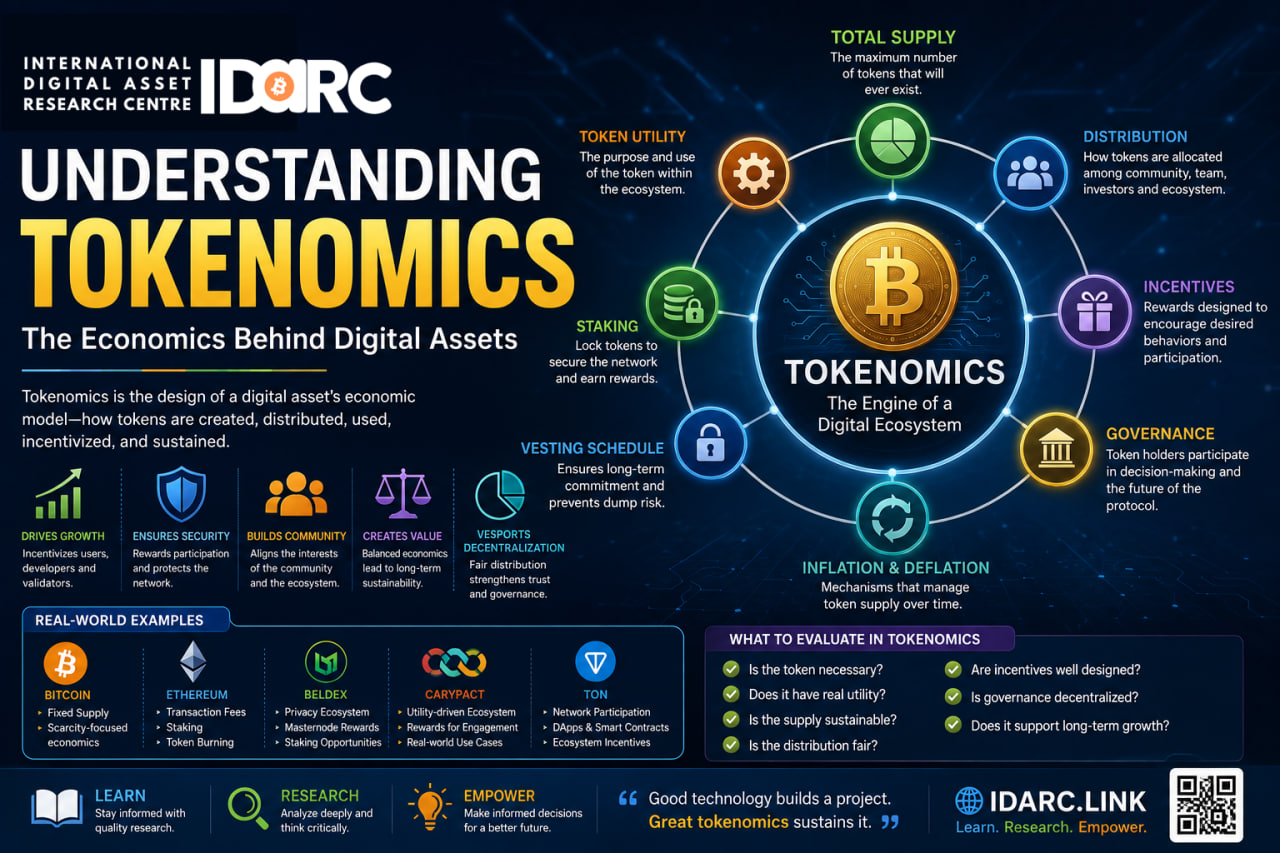
Understanding Tokenomics: The Economics Behind Digital Assets
Published by the International Digital Asset Research Centre (IDARC)
Introduction
Every successful digital asset project is built on more than innovative technology. Behind every cryptocurrency, blockchain platform, and decentralized ecosystem lies an economic framework that determines how the project functions, grows, and sustains itself over time. This framework is known as tokenomics.
Tokenomics influences everything from token supply and distribution to incentives, governance, staking, and long-term sustainability. A blockchain project may have excellent technology, but without sound tokenomics, it can struggle to attract users, maintain value, or build a healthy ecosystem.
For researchers, investors, developers, and policymakers, understanding tokenomics is essential when evaluating any digital asset project. This guide explains tokenomics in simple language, explores its key components, and demonstrates why it is one of the most important aspects of blockchain research.
What Is Tokenomics?
Tokenomics is the study and design of the economic model that governs a digital token within a blockchain ecosystem.
The word tokenomics combines two terms:
- Token
- Economics
It explains how a token is created, distributed, used, managed, and maintained throughout the life of a blockchain project.
Simply put,
Tokenomics defines how a digital asset creates value, encourages participation, and supports the long-term sustainability of a blockchain ecosystem.
Why Is Tokenomics Important?
A blockchain network relies on participants such as users, developers, validators, miners, investors, and businesses.
Tokenomics provides the incentives that encourage these participants to contribute to the ecosystem.
Well-designed tokenomics helps:
- Support network growth
- Encourage long-term participation
- Maintain economic balance
- Reward contributors
- Improve decentralization
- Promote ecosystem sustainability
Poor tokenomics, on the other hand, can lead to excessive inflation, weak adoption, centralization, or declining user confidence.
Key Components of Tokenomics
Understanding tokenomics begins with examining its core elements.
Total Supply
The total supply refers to the maximum number of tokens that will exist or the total number created by the project.
Some cryptocurrencies have a fixed supply, while others issue new tokens over time.
Example:
- Bitcoin has a maximum supply of 21 million BTC.
- Other projects may have no fixed supply limit.
Circulating Supply
The circulating supply represents the number of tokens currently available in the market.
Not every token created is immediately released.
Some may remain locked for founders, investors, ecosystem development, or future incentives.
Maximum Supply
Some projects establish a hard limit on token creation.
Limited supply can create scarcity if demand increases over time.
Not all blockchain projects use a maximum supply model.
Token Distribution
One of the most important areas of tokenomics is how tokens are allocated.
Typical allocations include:
- Community rewards
- Development team
- Advisors
- Early investors
- Foundation or treasury
- Marketing
- Ecosystem development
- Liquidity reserves
Researchers evaluate whether token distribution is fair and supports decentralization.
Token Utility
A token should have a clear purpose within its ecosystem.
Common utilities include:
- Transaction fees
- Governance voting
- Staking
- Network security
- Payments
- Access to decentralized applications
- Reward mechanisms
- Premium services
A token without meaningful utility often struggles to maintain long-term relevance.
Inflation and Deflation
Token supply can change over time.
Inflationary Tokenomics
New tokens are continuously created.
Advantages include:
- Ongoing validator rewards
- Ecosystem incentives
Challenges include:
- Potential dilution of existing holders
Deflationary Tokenomics
The circulating supply decreases over time through mechanisms such as token burning.
Reduced supply may increase scarcity if demand remains stable or grows.
Many projects combine both inflationary and deflationary mechanisms.
Token Burning
Token burning permanently removes tokens from circulation.
Projects burn tokens to:
- Reduce supply
- Improve scarcity
- Balance inflation
- Strengthen long-term sustainability
Burned tokens cannot be recovered.
Staking
Many blockchain networks encourage users to lock tokens to support network operations.
Participants may receive rewards for:
- Validating transactions
- Securing the blockchain
- Participating in governance
Staking aligns long-term incentives between users and the network.
Governance
Many blockchain ecosystems allow token holders to participate in decision-making.
Governance proposals may include:
- Protocol upgrades
- Fee adjustments
- Treasury spending
- Network parameters
- Community initiatives
Governance strengthens decentralization and community participation.
Vesting Schedules
Projects often restrict immediate access to tokens allocated to founders or early investors.
Vesting schedules gradually release tokens over time.
This helps:
- Prevent sudden market selling
- Encourage long-term commitment
- Improve investor confidence
Incentive Mechanisms
Tokenomics motivates participants through economic rewards.
Examples include:
- Validator rewards
- Mining rewards
- Staking rewards
- Liquidity incentives
- Referral programs
- Ecosystem grants
Strong incentives encourage network growth while maintaining economic balance.
How Researchers Analyze Tokenomics
When evaluating a blockchain project, researchers examine several important questions.
Is the Token Necessary?
Does the ecosystem genuinely require its native token?
Is Supply Sustainable?
Will inflation remain under control?
Is Distribution Fair?
Are tokens concentrated among a small number of holders?
Does the Token Have Utility?
Can users actively use the token within the ecosystem?
Are Incentives Balanced?
Do rewards encourage long-term participation rather than short-term speculation?
Is Governance Decentralized?
Can the community meaningfully influence future development?
Real-World Examples
Different blockchain ecosystems use different tokenomic models.
Bitcoin
- Fixed supply
- Mining rewards
- Halving events
- Scarcity-focused economics
Ethereum
- Transaction fees
- Staking
- Token burning
- Smart contract ecosystem
Beldex
- Privacy-focused ecosystem
- Masternode incentives
- Staking opportunities
- Utility across privacy services and decentralized applications
CaryPact
- Utility-driven ecosystem built on blockchain technology
- Token designed to support real-world business adoption and ecosystem participation
- Rewards for community engagement and network growth
- Focus on creating sustainable value through practical use cases, partnerships, and digital commerce
- Token utility integrated across the CaryPact ecosystem to encourage long-term participation rather than short-term speculation
TON (The Open Network)
- Network participation
- Smart contracts
- Decentralized applications
- Ecosystem incentives
Each project designs its tokenomics according to its technical architecture, governance model, and long-term ecosystem objectives. Studying multiple projects enables researchers to understand how different economic models influence adoption, sustainability, decentralization, and network growth.
Common Mistakes When Evaluating Tokenomics
Many beginners focus only on token price.
Researchers look much deeper.
Avoid these common mistakes:
- Ignoring token supply
- Overlooking inflation
- Not studying token distribution
- Ignoring vesting schedules
- Assuming scarcity guarantees value
- Confusing popularity with utility
Understanding tokenomics provides a much more complete picture than market price alone.
Characteristics of Strong Tokenomics
Well-designed tokenomics generally demonstrates:
- Clear utility
- Sustainable supply
- Balanced incentives
- Transparent distribution
- Community governance
- Long-term economic planning
- Security incentives
- Responsible treasury management
Strong tokenomics supports ecosystem growth rather than short-term speculation.
The Future of Tokenomics
Tokenomics continues to evolve as blockchain technology advances.
Emerging trends include:
- Tokenized real-world assets (RWAs)
- AI-powered economic models
- Dynamic supply mechanisms
- Cross-chain token ecosystems
- Decentralized autonomous organizations (DAOs)
- Sustainable staking models
- Institutional tokenization
- Programmable digital assets
Future blockchain ecosystems are expected to implement increasingly sophisticated economic systems that balance growth, security, decentralization, and sustainability.
Conclusion
Tokenomics is one of the most important aspects of every digital asset project. It determines how tokens are created, distributed, utilized, and governed while providing the economic incentives that support an ecosystem’s long-term success.
Understanding tokenomics allows researchers, investors, developers, and policymakers to evaluate blockchain projects beyond market prices and promotional materials. By analyzing supply, utility, governance, incentives, and sustainability, readers gain a clearer understanding of a project’s true potential.
In the rapidly evolving digital economy, technology builds the network—but tokenomics determines whether that network can thrive.
Key Takeaways
- Tokenomics is the economic framework governing a blockchain project’s digital token.
- It includes supply, distribution, utility, governance, incentives, and sustainability.
- Strong tokenomics supports long-term ecosystem growth.
- Researchers evaluate token utility, token distribution, inflation, governance, and incentive structures.
- Understanding tokenomics is essential before investing in or researching any digital asset project.
- Sound tokenomics contributes to sustainable blockchain ecosystems and responsible innovation.
About the International Digital Asset Research Centre (IDARC)
The International Digital Asset Research Centre (IDARC) is an independent research and educational institution dedicated to advancing awareness, education, and evidence-based research in digital assets, blockchain technology, Web3, decentralized finance, tokenization, cybersecurity, and emerging digital ecosystems.
Through research publications, whitepaper analysis, educational initiatives, policy dialogue, and public awareness programs, IDARC empowers researchers, professionals, legal practitioners, businesses, policymakers, and the public with trusted knowledge that supports informed participation in the rapidly evolving digital economy.
Motto: Learn. Research. Empower.
Website: https://IDARC.Link
0 Comments