Top 50 Digital Asset Projects Worth Studying
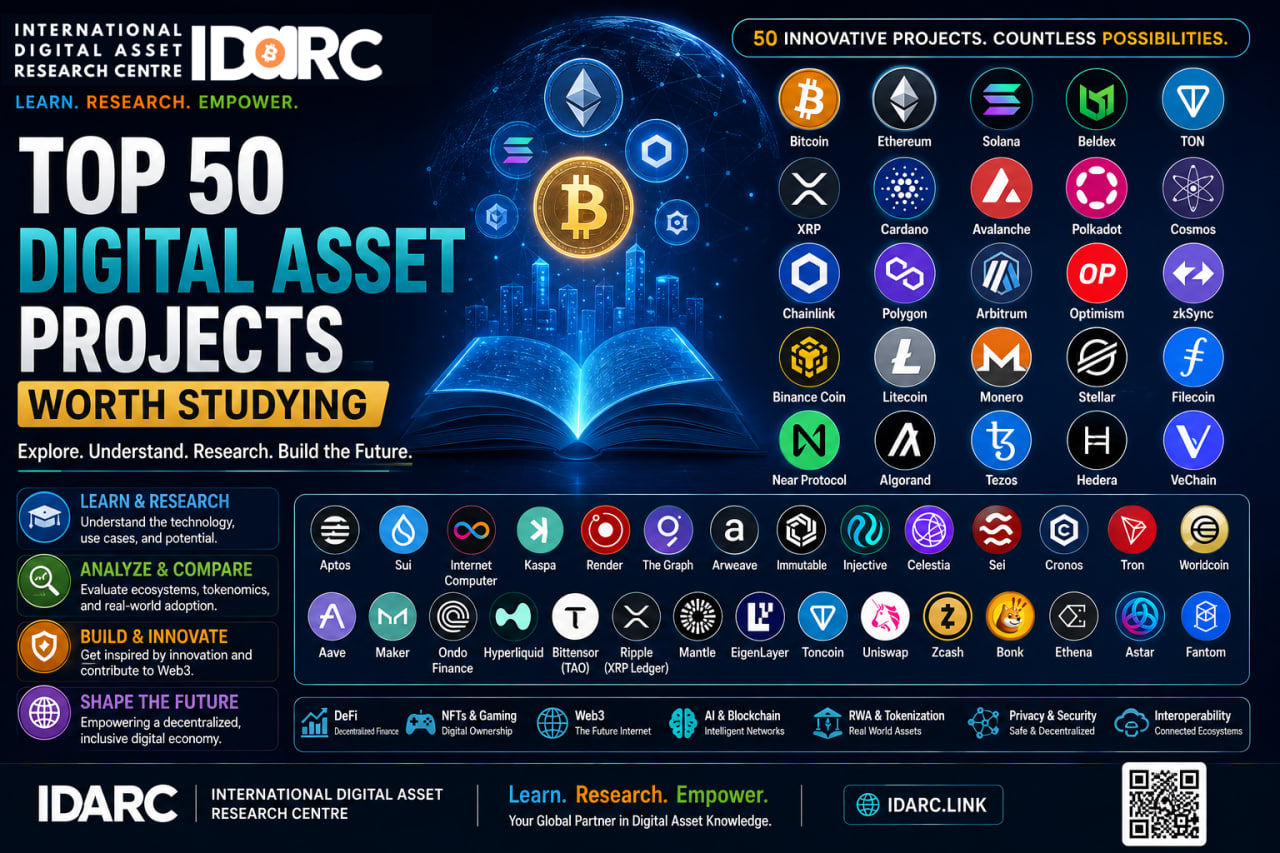
Top 50 Digital Asset Projects Worth Studying
Published by the International Digital Asset Research Centre (IDARC)
Introduction
The digital asset industry has evolved from a single cryptocurrency into a global ecosystem comprising thousands of blockchain projects. These projects span decentralized finance (DeFi), smart contract platforms, digital payments, privacy technologies, decentralized storage, artificial intelligence, gaming, tokenization, interoperability, and enterprise blockchain solutions.
While many projects enter the market every year, only a relatively small number have demonstrated meaningful technological innovation, active development, strong communities, or real-world adoption. Understanding these leading ecosystems is essential for researchers, developers, investors, policymakers, legal professionals, and students seeking a comprehensive understanding of the blockchain industry.
This article presents 50 digital asset projects that are worth studying, not as investment recommendations, but as important case studies that have significantly influenced the evolution of blockchain technology and the digital economy.
Why Study Digital Asset Projects?
Studying established blockchain ecosystems helps develop a deeper understanding of:
- Blockchain architecture
- Consensus mechanisms
- Tokenomics
- Smart contracts
- Governance models
- Privacy technologies
- Interoperability
- Decentralized applications (dApps)
- Digital identity
- Real-world adoption
Rather than focusing solely on price movements, researchers examine how projects solve practical problems and contribute to technological innovation.
Selection Criteria
The projects included in this list have been selected based on factors such as:
- Technological innovation
- Industry influence
- Developer activity
- Ecosystem growth
- Real-world use cases
- Community engagement
- Security
- Educational value
- Historical significance
- Long-term research importance
The order below is alphabetical and does not represent rankings or investment recommendations.
Top 50 Digital Asset Projects Worth Studying
1. Aptos (APT)
A Layer 1 blockchain designed for scalability, security, and parallel transaction execution using the Move programming language.
2. Arbitrum (ARB)
A Layer 2 scaling solution that enhances Ethereum’s transaction speed and reduces costs.
3. Avalanche (AVAX)
A high-performance blockchain platform known for rapid transaction finality and customizable subnet architecture.
4. Beldex (BDX)
A privacy-focused blockchain ecosystem that integrates confidential transactions, decentralized communication, browser technology, decentralized domains, and privacy-preserving infrastructure.
5. Binance Coin (BNB)
The native asset of the BNB Chain ecosystem, supporting decentralized applications, payments, and blockchain services.
6. Bitcoin (BTC)
The world’s first decentralized cryptocurrency and the foundation of blockchain technology.
7. Cardano (ADA)
A research-driven blockchain platform emphasizing peer-reviewed development and sustainability.
8. Celestia (TIA)
A modular blockchain network that separates consensus from execution, enabling scalable blockchain infrastructure.
9. Chainlink (LINK)
A decentralized oracle network connecting blockchain smart contracts with real-world data.
10. Cosmos (ATOM)
A blockchain ecosystem designed to enable interoperability among independent blockchain networks.
11. Cronos (CRO)
A blockchain supporting decentralized finance, NFTs, and Web3 applications.
12. Dogecoin (DOGE)
Originally created as a meme cryptocurrency, Dogecoin has grown into one of the most recognized digital assets globally.
13. Ethereum (ETH)
The leading smart contract blockchain powering decentralized finance, NFTs, DAOs, and thousands of decentralized applications.
14. Filecoin (FIL)
A decentralized storage network enabling secure and distributed data storage.
15. Hedera (HBAR)
A distributed ledger platform using Hashgraph consensus for enterprise applications.
16. Hyperliquid (HYPE)
A decentralized trading ecosystem designed for high-performance perpetual futures markets.
17. Internet Computer (ICP)
A blockchain platform that aims to host complete internet applications directly on decentralized infrastructure.
18. Kaspa (KAS)
A high-speed blockchain implementing the BlockDAG architecture for scalable transactions.
19. Litecoin (LTC)
One of the earliest cryptocurrencies, designed for faster payment confirmation than Bitcoin.
20. Mantle (MNT)
An Ethereum Layer 2 ecosystem focused on scalability and decentralized governance.
21. Monero (XMR)
A privacy-focused cryptocurrency known for confidential transactions and strong anonymity features.
22. Near Protocol (NEAR)
A developer-friendly blockchain platform emphasizing scalability and usability.
23. Optimism (OP)
An Ethereum Layer 2 network utilizing optimistic rollup technology.
24. Polkadot (DOT)
A multi-chain ecosystem enabling communication and interoperability between specialized blockchains.
25. Polygon (POL)
A widely adopted blockchain ecosystem offering multiple Ethereum scaling technologies.
26. Render (RENDER)
A decentralized GPU computing network supporting digital rendering and artificial intelligence workloads.
27. Ripple (XRP Ledger)
A blockchain focused on fast, efficient cross-border payment infrastructure.
28. Sei (SEI)
A Layer 1 blockchain optimized for high-speed digital asset trading.
29. Solana (SOL)
A high-performance blockchain supporting decentralized finance, gaming, and NFT ecosystems.
30. Stellar (XLM)
A blockchain designed to facilitate global financial inclusion and international payments.
31. Sui (SUI)
A scalable Layer 1 blockchain utilizing the Move programming language.
32. TAO (Bittensor)
A decentralized artificial intelligence network rewarding machine learning contributions.
33. Tezos (XTZ)
A self-amending blockchain supporting on-chain governance and smart contracts.
34. The Graph (GRT)
An indexing protocol that enables efficient querying of blockchain data.
35. TON (The Open Network)
A scalable blockchain ecosystem supporting payments, decentralized applications, and Telegram-based Web3 services.
36. Tron (TRX)
A blockchain platform focusing on digital content, decentralized applications, and stablecoin activity.
37. Uniswap (UNI)
The leading decentralized exchange protocol built on Ethereum.
38. VeChain (VET)
A blockchain platform specializing in supply chain transparency and enterprise solutions.
39. Worldcoin (WLD)
A digital identity and blockchain project exploring proof-of-personhood technologies.
40. XRP
One of the most widely studied digital assets for international payment infrastructure and enterprise financial applications.
41. Zcash (ZEC)
A privacy-oriented cryptocurrency utilizing zero-knowledge cryptography.
42. zkSync (ZK)
A Layer 2 Ethereum scaling solution based on zero-knowledge proofs.
43. Immutable (IMX)
A blockchain platform designed specifically for gaming and NFT infrastructure.
44. Algorand (ALGO)
A blockchain emphasizing speed, security, and sustainable consensus mechanisms.
45. Arweave (AR)
A decentralized permanent storage network for preserving digital information.
46. EigenLayer (EIGEN)
A protocol introducing restaking to expand Ethereum’s shared security model.
47. Ondo Finance (ONDO)
A blockchain project focused on tokenized real-world assets and institutional finance.
48. Aave (AAVE)
A decentralized lending and borrowing protocol that pioneered many innovations in DeFi.
49. Maker (MKR)
The governance protocol behind the DAI decentralized stablecoin ecosystem.
50. Injective (INJ)
A Layer 1 blockchain optimized for decentralized finance, derivatives, and cross-chain trading applications.
What Should You Study in Each Project?
Rather than concentrating only on market capitalization or token prices, examine the following aspects:
Vision
What problem does the project aim to solve?
Technology
What blockchain architecture and consensus mechanism are used?
Tokenomics
How is the token distributed and utilized?
Governance
Who makes decisions within the ecosystem?
Security
Has the project undergone independent security audits?
Ecosystem
How active are developers, users, validators, and community members?
Whitepaper
Does the project provide a clear and technically sound explanation of its objectives?
Real-World Adoption
Are businesses, governments, developers, or institutions actively using the technology?
Building Your Research Framework
When studying any digital asset project, create a structured research process.
Evaluate:
- Whitepaper
- Official documentation
- Tokenomics
- Technical architecture
- Governance
- Development roadmap
- Security audits
- Community engagement
- GitHub activity
- Regulatory considerations
- Partnerships
- Real-world applications
Maintaining a consistent research framework enables objective comparison across different blockchain ecosystems.
Why Continuous Research Matters
The blockchain industry evolves rapidly. New technologies, consensus mechanisms, regulatory frameworks, and decentralized applications emerge every year.
Researchers should continuously update their knowledge by reviewing project documentation, monitoring ecosystem developments, and comparing innovations across multiple blockchain networks.
Education and research remain the strongest foundations for responsible participation in the digital asset economy.
Conclusion
The digital asset ecosystem extends far beyond cryptocurrency trading. It represents a diverse collection of technologies that are transforming finance, supply chains, digital identity, healthcare, gaming, artificial intelligence, communications, and countless other industries.
Studying these 50 projects provides valuable insight into the evolution of blockchain technology and the future of decentralized innovation. Rather than following short-term market trends, researchers should focus on understanding the technology, governance, tokenomics, security, and real-world impact of each ecosystem.
Knowledge gained through disciplined research is far more valuable than speculation and serves as the foundation for informed decision-making in the rapidly evolving digital economy.
Key Takeaways
- The digital asset ecosystem includes thousands of blockchain projects with diverse applications.
- Studying blockchain projects requires evaluating technology, governance, security, tokenomics, and real-world adoption.
- Whitepapers and official documentation are the primary sources for understanding a project.
- A structured research framework helps compare blockchain ecosystems objectively.
- Continuous learning is essential because blockchain technology evolves rapidly.
- Knowledge and research are the most valuable assets in the digital economy.
About the International Digital Asset Research Centre (IDARC)
The International Digital Asset Research Centre (IDARC) is an independent research and educational institution dedicated to advancing awareness, education, and evidence-based research in digital assets, blockchain technology, Web3, decentralized finance, tokenization, cybersecurity, and emerging digital ecosystems.
Through research publications, whitepaper analysis, educational initiatives, policy dialogue, and public awareness programs, IDARC empowers researchers, professionals, legal practitioners, businesses, policymakers, and the public with trusted knowledge that supports informed participation in the rapidly evolving digital economy.
Motto: Learn. Research. Empower.
Website: https://IDARC.Link
0 Comments