Digital Wallets Explained: A Beginner’s Guide to Storing Digital Assets Safely
Digital Wallets Explained: A Beginner’s Guide to Storing Digital Assets Safely
Published by the International Digital Asset Research Centre (IDARC)
Introduction
As blockchain technology and digital assets continue to gain global adoption, one of the first concepts every beginner encounters is the digital wallet. Whether you are buying Bitcoin, using Ethereum, collecting NFTs, or interacting with Web3 applications, a digital wallet serves as your gateway to the blockchain ecosystem.
Despite the name, a digital wallet does not actually store cryptocurrencies in the same way a physical wallet stores cash. Instead, it securely manages the cryptographic keys that allow you to access, send, receive, and control your digital assets on a blockchain.
Understanding how digital wallets work is essential for anyone interested in cryptocurrencies, tokenized assets, decentralized finance (DeFi), or Web3. This guide explains digital wallets in simple language, explores their different types, and outlines best practices for keeping digital assets secure.
What Is a Digital Wallet?
A digital wallet, also known as a crypto wallet or blockchain wallet, is a software application or physical device that securely stores the cryptographic keys required to access and manage digital assets on a blockchain.
Rather than holding cryptocurrencies themselves, the wallet stores the private keys and public keys that prove ownership and authorize blockchain transactions.
Simply put,
A digital wallet is a secure tool that allows you to access, manage, send, and receive digital assets on a blockchain.
How Does a Digital Wallet Work?
Every blockchain wallet generates two important cryptographic keys.
Public Key
The public key functions like a bank account number.
It can be safely shared with others so they can send digital assets to your wallet.
Private Key
The private key functions like the password or master key to your digital assets.
Only the wallet owner should know the private key.
Anyone with access to the private key can control the assets associated with that wallet.
Understanding Through a Simple Example
Imagine your home.
- Your home address is like your wallet address—you can share it with anyone who wants to send you a package.
- Your house key is like your private key—only you should possess it.
- Your locker represents your digital wallet, securely protecting your keys.
The digital assets themselves remain on the blockchain. Your wallet simply provides secure access to them.
What Does a Digital Wallet Store?
A digital wallet typically manages:
- Private keys
- Public keys
- Wallet addresses
- Transaction history
- Digital asset balances
- NFT collections
- Token holdings
- Smart contract permissions
The blockchain stores the actual assets, while the wallet provides secure access.
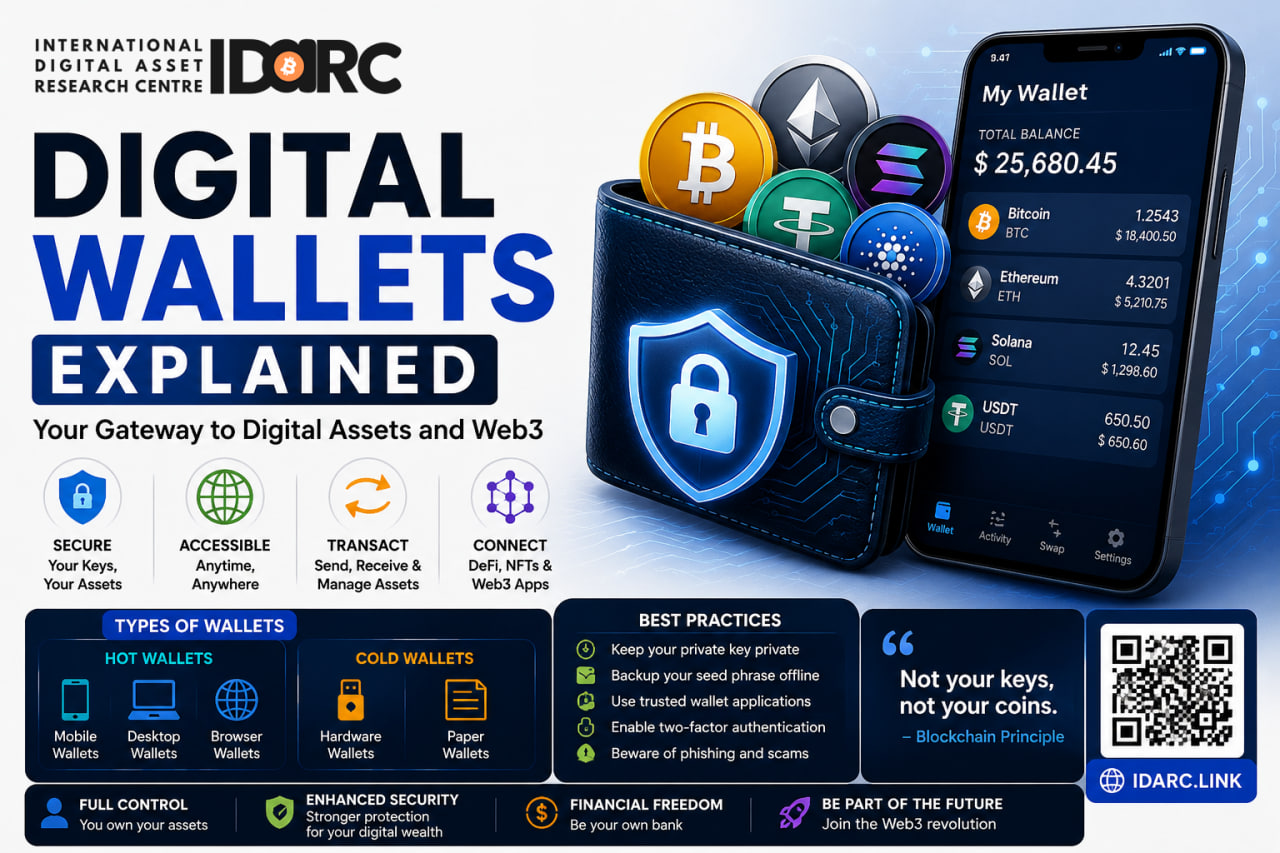
Types of Digital Wallets
Digital wallets are generally divided into two broad categories.
Hot Wallets
Hot wallets remain connected to the internet.
Examples include:
- Mobile wallets
- Desktop wallets
- Browser extension wallets
- Web wallets
Advantages
- Easy to use
- Fast transactions
- Convenient for daily use
- Supports decentralized applications (dApps)
Limitations
- More vulnerable to cyberattacks
- Greater exposure to phishing and malware
Cold Wallets
Cold wallets remain offline except when needed.
Examples include:
- Hardware wallets
- Paper wallets (largely obsolete and generally discouraged)
- Air-gapped storage solutions
Advantages
- Higher security
- Better protection from online attacks
- Suitable for long-term storage
Limitations
- Less convenient for frequent transactions
- Hardware devices may involve additional cost
Custodial vs Non-Custodial Wallets
Custodial Wallets
A third party, such as a cryptocurrency exchange, manages the private keys on behalf of the user.
Examples include wallets provided by many centralized exchanges.
Benefits
- Easy account recovery
- Beginner-friendly
- Simplified user experience
Considerations
- Users do not directly control their private keys.
- Security also depends on the service provider.
Non-Custodial Wallets
Users maintain full control of their private keys.
The responsibility for security and backup rests entirely with the wallet owner.
This follows the blockchain principle:
“Not your keys, not your coins.”
Popular Types of Wallet Applications
Mobile Wallets
Designed for smartphones and everyday transactions.
Desktop Wallets
Installed on personal computers and often provide advanced features.
Browser Wallets
Browser extensions that connect directly with Web3 applications and decentralized exchanges.
Hardware Wallets
Dedicated physical devices designed to keep private keys offline.
What Is a Seed Phrase?
When creating most non-custodial wallets, users receive a seed phrase, also known as a recovery phrase.
This is typically a sequence of 12, 18, or 24 words that can restore access to the wallet if the original device is lost or damaged.
The seed phrase is the ultimate backup.
Anyone who knows the seed phrase can access the wallet.
It should never be shared or stored insecurely.
How to Use a Digital Wallet
The basic process is straightforward.
Step 1
Create a wallet using trusted wallet software or hardware.
Step 2
Securely back up the seed phrase.
Step 3
Receive digital assets using your public wallet address.
Step 4
Send assets by entering the recipient’s wallet address and confirming the transaction.
Step 5
Monitor transactions and balances directly through the wallet.
Common Uses of Digital Wallets
Digital wallets support a wide range of blockchain activities.
- Sending cryptocurrency
- Receiving digital assets
- Storing NFTs
- Participating in DeFi
- Token staking
- Accessing Web3 applications
- Managing digital identities
- Signing blockchain transactions
- Voting in decentralized governance systems
Security Best Practices
Protecting a digital wallet requires careful security practices.
- Never share your private key.
- Never reveal your seed phrase.
- Enable two-factor authentication where available.
- Verify wallet addresses before sending funds.
- Download wallet software only from official sources.
- Keep wallet software updated.
- Use strong passwords.
- Store recovery phrases offline.
- Consider hardware wallets for significant holdings.
- Beware of phishing websites and fake wallet applications.
Common Mistakes to Avoid
Many users lose digital assets because of preventable mistakes.
These include:
- Sharing private keys
- Storing seed phrases online
- Falling victim to phishing attacks
- Downloading fake wallet applications
- Sending assets to incorrect blockchain networks
- Losing hardware wallets without backups
Unlike traditional banking systems, blockchain transactions are generally irreversible.
Advantages of Digital Wallets
Digital wallets offer several important benefits.
- Full control over digital assets
- Global accessibility
- Fast transactions
- Secure cryptographic protection
- Support for multiple cryptocurrencies
- Integration with Web3 applications
- NFT management
- Direct blockchain interaction
Challenges
Digital wallets also present certain challenges.
- Responsibility for self-custody
- Cybersecurity threats
- Technical learning curve
- Irreversible transactions
- Regulatory considerations
- Device security risks
Education and responsible security practices remain essential.
Digital Wallets vs Traditional Bank Accounts
| Feature | Traditional Bank Account | Digital Wallet |
|---|---|---|
| Controlled By | Bank | User or Custodian |
| Access | Banking System | Blockchain Network |
| Identity | Personal Identification | Cryptographic Keys |
| Operating Hours | Business Hours | 24/7 |
| International Transfers | Often slower | Typically faster, depending on the blockchain |
| Asset Control | Bank-managed | User-controlled (non-custodial) |
The Future of Digital Wallets
Digital wallets are rapidly evolving beyond cryptocurrency storage.
Future innovations include:
- Self-sovereign digital identity
- Central Bank Digital Currency (CBDC) support
- Biometric authentication
- Tokenized real-world assets
- Digital credentials
- Cross-chain interoperability
- AI-assisted security
- Enterprise digital identity management
As blockchain adoption continues to expand, digital wallets are expected to become a central component of digital finance, digital identity, and Web3 participation.
Conclusion
Digital wallets are an essential part of the blockchain ecosystem. They enable users to securely manage cryptographic keys, access digital assets, and interact with decentralized applications while maintaining control over their digital ownership.
Whether you are investing in cryptocurrencies, collecting NFTs, participating in decentralized finance, or exploring Web3, understanding how digital wallets work is one of the most important steps toward responsible participation in the digital economy.
With proper security practices and informed decision-making, digital wallets provide a secure and efficient gateway to the future of digital assets.
Key Takeaways
- A digital wallet manages cryptographic keys rather than storing cryptocurrencies directly.
- Public keys receive assets, while private keys authorize transactions.
- Digital wallets are available as hot wallets and cold wallets.
- Non-custodial wallets provide full user control but require careful security.
- Protecting your seed phrase is essential for safeguarding digital assets.
- Digital wallets are the gateway to blockchain, Web3, DeFi, NFTs, and tokenized assets.
About the International Digital Asset Research Centre (IDARC)
The International Digital Asset Research Centre (IDARC) is an independent research and educational institution dedicated to advancing awareness, education, and evidence-based research in digital assets, blockchain technology, Web3, decentralized finance, tokenization, cybersecurity, and emerging digital ecosystems.
Through research publications, whitepaper analysis, educational initiatives, policy dialogue, and public awareness programs, IDARC empowers researchers, professionals, legal practitioners, businesses, policymakers, and the public with trusted knowledge that supports informed participation in the rapidly evolving digital economy.
Motto: Learn. Research. Empower.
Website: https://IDARC.Link
0 Comments