Public Key vs Private Key: Understanding the Foundation of Blockchain Security
Public Key vs Private Key: Understanding the Foundation of Blockchain Security
Published by the International Digital Asset Research Centre (IDARC)
Introduction
Every cryptocurrency transaction, blockchain wallet, and digital asset depends on one of the most important concepts in modern cryptography: public keys and private keys. Whether you are sending Bitcoin, storing Ethereum, accessing a Web3 application, or managing NFTs, these two cryptographic keys work together to secure your digital assets and verify ownership.
Many beginners assume that cryptocurrencies are stored inside a wallet. In reality, digital assets always remain on the blockchain. What your wallet stores are the cryptographic keys that allow you to access and control those assets.
Understanding the difference between a public key and a private key is essential for anyone entering the world of blockchain, cryptocurrencies, Web3, or digital assets. This guide explains both concepts in simple language and highlights why protecting your private key is one of the most important responsibilities in digital asset ownership.
What Are Cryptographic Keys?
Blockchain networks use a technology called public-key cryptography, also known as asymmetric cryptography, to secure transactions and prove ownership.
Every blockchain wallet generates two mathematically related keys:
- A Public Key
- A Private Key
These keys work together to ensure that only the rightful owner can access and transfer digital assets.
Simply put,
A public key receives digital assets, while a private key gives you the authority to control and spend them.
What Is a Public Key?
A public key is a cryptographic key that can be safely shared with others.
It is used to generate your wallet address, allowing people to send cryptocurrencies or other digital assets to you.
Think of it as your bank account number.
Anyone can know your public key or wallet address without compromising your security.
Public Key Characteristics
- Safe to share
- Used for receiving digital assets
- Generated from the private key through cryptographic algorithms
- Does not allow others to spend your assets
- Can be used to verify digital signatures
What Is a Private Key?
A private key is a secret cryptographic key that proves ownership of your blockchain wallet.
It authorizes transactions and allows you to send, transfer, or manage your digital assets.
Think of it as the master password to your digital wealth.
Anyone who possesses your private key has complete control over your assets.
Private Key Characteristics
- Must remain secret
- Used to sign blockchain transactions
- Proves ownership of digital assets
- Cannot be safely shared
- Grants full control over wallet funds
Understanding Through a Simple Example
Imagine your home.
- Your home address is your public key.
- Anyone can know your address and send you a parcel.
- Your house key is your private key.
- Only you should possess the key that unlocks your home.
The same principle applies to blockchain wallets.
People can send assets using your public address, but only your private key can authorize outgoing transactions.
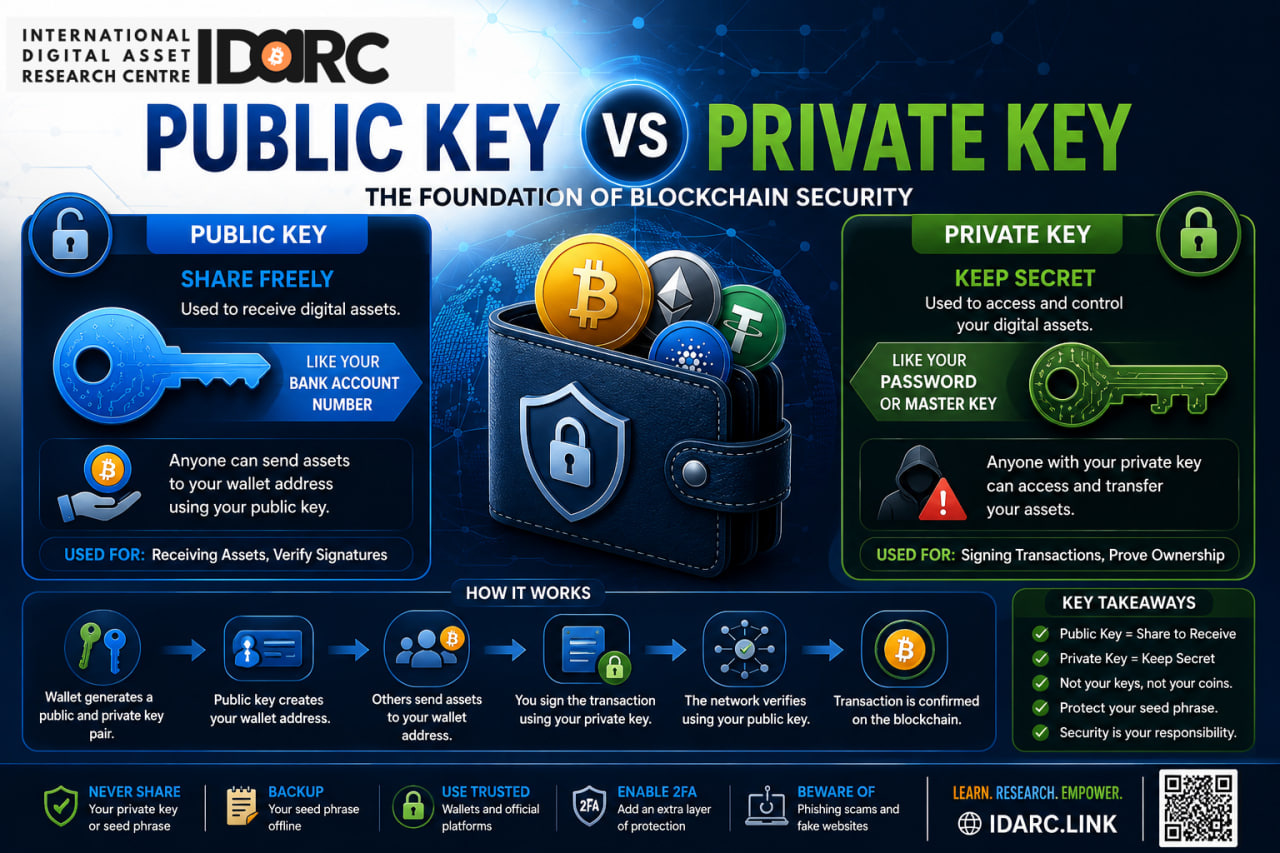
How Public and Private Keys Work Together
The process follows a secure sequence.
Step 1
A wallet generates a private key.
Step 2
The public key is mathematically derived from the private key.
Step 3
The public key generates a wallet address.
Step 4
Someone sends cryptocurrency to your wallet address.
Step 5
When you decide to transfer assets, your wallet uses the private key to digitally sign the transaction.
Step 6
The blockchain verifies the signature using the corresponding public key before approving the transaction.
This process ensures security without exposing your private key.
Public Key vs Private Key
| Feature | Public Key | Private Key |
|---|---|---|
| Purpose | Receive digital assets | Control and spend digital assets |
| Visibility | Public | Secret |
| Can Be Shared | Yes | Never |
| Used For | Wallet addresses and signature verification | Transaction authorization and digital signatures |
| Security Risk | Low | Extremely High |
| Ownership Control | No | Yes |
What Is a Wallet Address?
A wallet address is a shortened representation of your public key.
Instead of sharing a long cryptographic string, blockchain users typically share wallet addresses when receiving digital assets.
Example:
bc1qxxxxxxxxxxxxxxxxxxxxxxxxxxxxxxxx
The wallet address is safe to share publicly.
What Is a Digital Signature?
Whenever you send cryptocurrency, your wallet creates a digital signature using your private key.
The blockchain network verifies this signature using your public key.
This confirms that:
- You are the legitimate owner.
- The transaction has not been altered.
- The private key remains confidential.
Why Is the Private Key So Important?
The private key is the single most important piece of information associated with your blockchain wallet.
If you lose it:
- You may permanently lose access to your digital assets.
If someone steals it:
- They can transfer your assets without your permission.
Unlike traditional banking systems, blockchain transactions are generally irreversible.
There is usually no central authority that can recover a lost private key.
What Is a Seed Phrase?
Most wallets generate a seed phrase (also called a recovery phrase) consisting of 12, 18, or 24 words.
The seed phrase is used to recreate your private keys if your wallet is lost, damaged, or replaced.
Because the seed phrase can restore your wallet, it must be protected with the same level of care as your private key.
Best Practices for Protecting Your Private Key
Security should always be your highest priority.
Follow these best practices:
- Never share your private key with anyone.
- Never reveal your seed phrase.
- Store backups offline in a secure location.
- Use hardware wallets for significant holdings.
- Enable two-factor authentication where available.
- Download wallet software only from official sources.
- Verify websites before entering wallet information.
- Beware of phishing attacks and fake wallet applications.
Common Mistakes to Avoid
Many users lose digital assets because of preventable errors.
These include:
- Sharing private keys.
- Storing seed phrases online.
- Saving recovery phrases in cloud storage.
- Clicking phishing links.
- Downloading fake wallet applications.
- Entering recovery phrases into fraudulent websites.
Remember:
If someone asks for your private key or recovery phrase, it is almost certainly a scam.
Real-World Applications
Public and private keys secure much more than cryptocurrencies.
They are used in:
- Blockchain wallets
- Cryptocurrency transactions
- Smart contracts
- NFTs
- Digital identity
- Secure messaging
- Digital signatures
- Enterprise cybersecurity
- Government digital services
- Decentralized Finance (DeFi)
Advantages of Public-Key Cryptography
This technology provides several important benefits.
- Strong security
- Secure ownership verification
- Digital signatures
- Data integrity
- Privacy protection
- Authentication
- Non-repudiation
- Global interoperability
Common Misconceptions
Public Keys Should Be Kept Secret
False.
Public keys and wallet addresses are designed to be shared for receiving digital assets.
Private Keys Can Be Recovered
Usually not.
If you lose both your private key and your recovery phrase, your assets may become permanently inaccessible.
Cryptocurrency Is Stored Inside the Wallet
Not exactly.
Digital assets remain on the blockchain.
The wallet stores the keys that allow you to access and manage those assets.
The Future of Blockchain Security
As blockchain technology evolves, wallet security continues to improve through innovations such as:
- Multi-signature wallets
- Hardware security modules
- Biometric authentication
- Multi-party computation (MPC)
- Passwordless authentication
- Self-sovereign digital identity
- Quantum-resistant cryptography
- AI-assisted threat detection
These advancements aim to make digital asset management both more secure and more user-friendly.
Conclusion
Public and private keys form the foundation of blockchain security. Together, they enable secure ownership, authentication, and transfer of digital assets without relying on centralized intermediaries.
While the public key allows others to send assets to your wallet, the private key gives you exclusive authority to control those assets. Protecting your private key and recovery phrase is therefore essential to safeguarding your digital wealth.
Understanding these concepts is a critical step for anyone exploring cryptocurrencies, blockchain technology, Web3, or the broader digital asset ecosystem.
Key Takeaways
- Every blockchain wallet contains a public key and a private key.
- Public keys are used to receive digital assets and can be shared safely.
- Private keys authorize transactions and must always remain confidential.
- Wallet addresses are derived from public keys.
- Seed phrases can restore access to private keys if stored securely.
- Protecting your private key is fundamental to maintaining ownership and security in the blockchain ecosystem.
About the International Digital Asset Research Centre (IDARC)
The International Digital Asset Research Centre (IDARC) is an independent research and educational institution dedicated to advancing awareness, education, and evidence-based research in digital assets, blockchain technology, Web3, decentralized finance, tokenization, cybersecurity, and emerging digital ecosystems.
Through research publications, whitepaper analysis, educational initiatives, policy dialogue, and public awareness programs, IDARC empowers researchers, professionals, legal practitioners, businesses, policymakers, and the public with trusted knowledge that supports informed participation in the rapidly evolving digital economy.
Motto: Learn. Research. Empower.
Website: https://IDARC.Link
0 Comments