What Is Bitcoin and Why Was It Created?
What Is Bitcoin and Why Was It Created?
Published by the International Digital Asset Research Centre (IDARC)
Introduction
Bitcoin is widely recognized as the world’s first decentralized cryptocurrency and the foundation of the modern digital asset ecosystem. Since its introduction in 2009, Bitcoin has transformed global discussions around money, finance, technology, and digital ownership. It has inspired thousands of cryptocurrencies, accelerated blockchain innovation, and introduced entirely new concepts such as decentralized finance (DeFi), tokenization, and Web3.
Despite its popularity, many people still ask fundamental questions: What exactly is Bitcoin? Why was it created? How does it work? Why has it become so valuable?
Understanding Bitcoin begins with understanding the problems it was designed to solve. It was not created simply as a digital currency but as an alternative financial system that enables secure, transparent, and peer-to-peer transactions without relying on central authorities.
This article explores the origins of Bitcoin, its purpose, technology, advantages, limitations, and its role in shaping the future of the digital economy.
What Is Bitcoin?
Bitcoin (BTC) is a decentralized digital currency that allows people to send and receive money directly over the internet without the need for banks, payment processors, or other financial intermediaries.
Unlike traditional currencies issued by governments, Bitcoin operates on a decentralized blockchain network maintained by thousands of computers worldwide. Every transaction is verified using cryptography and recorded permanently on a public blockchain.
Bitcoin has no physical form. It exists entirely in digital form and can be securely stored, transferred, and exchanged anywhere in the world.
Simply put,
Bitcoin is a decentralized digital currency that enables secure, borderless, peer-to-peer transactions through blockchain technology.
Who Created Bitcoin?
Bitcoin was introduced in 2008 by an individual or group using the pseudonym Satoshi Nakamoto.
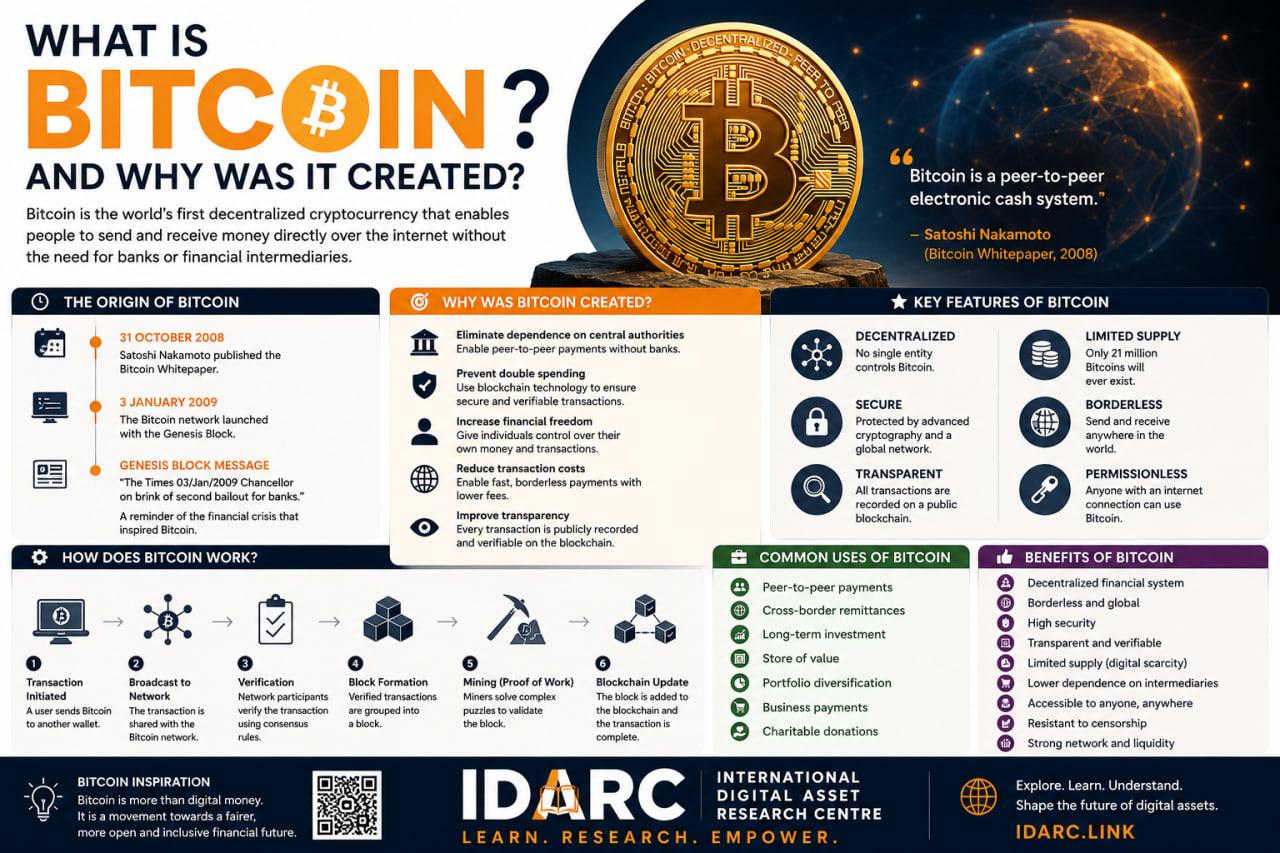
On 31 October 2008, Satoshi published the Bitcoin Whitepaper titled:
“Bitcoin: A Peer-to-Peer Electronic Cash System.”
The whitepaper described a revolutionary system that would enable online payments to be sent directly from one person to another without requiring a trusted financial institution.
The Bitcoin network officially launched on 3 January 2009, when the first block, known as the Genesis Block, was mined.
To this day, the true identity of Satoshi Nakamoto remains unknown.
Why Was Bitcoin Created?
Bitcoin was created to address several limitations of the traditional financial system.
Eliminating Dependence on Central Authorities
Traditional financial transactions rely on banks and payment processors to verify and process payments.
Bitcoin enables individuals to transact directly with one another without requiring a central intermediary.
Preventing Double Spending
One of the biggest challenges of digital money was ensuring that the same digital currency could not be spent twice.
Bitcoin solved this problem using blockchain technology and a decentralized consensus mechanism.
Increasing Financial Freedom
Bitcoin gives individuals complete control over their own money without requiring permission from banks or governments to send or receive payments.
Reducing Transaction Costs
International money transfers often involve multiple intermediaries and high fees.
Bitcoin enables cross-border transactions without many of these traditional intermediaries.
Improving Transparency
Every Bitcoin transaction is permanently recorded on a public blockchain, allowing anyone to verify transaction history while preserving user privacy through cryptographic addresses.
The Global Financial Context
Bitcoin emerged during the global financial crisis of 2008.
The collapse of major financial institutions and declining public confidence in centralized banking systems highlighted concerns about financial stability, transparency, and monetary policy.
The Genesis Block contains a newspaper headline that reflects this historical context:
“The Times 03/Jan/2009 Chancellor on brink of second bailout for banks.”
This message is widely interpreted as a reference to the financial environment that inspired Bitcoin’s creation.
How Does Bitcoin Work?
Bitcoin operates through blockchain technology.
The process is straightforward.
Step 1: Transaction Initiation
A user sends Bitcoin from their digital wallet to another wallet.
Step 2: Network Broadcast
The transaction is shared with thousands of computers participating in the Bitcoin network.
Step 3: Verification
Network participants verify the transaction according to Bitcoin’s consensus rules.
Step 4: Block Formation
Verified transactions are grouped into a block.
Step 5: Mining
Specialized computers compete to validate the block through a process known as Proof of Work (PoW).
Step 6: Blockchain Update
Once validated, the block is permanently added to the blockchain, and the transaction becomes part of Bitcoin’s immutable ledger.
Key Features of Bitcoin
Decentralization
Bitcoin is not controlled by any government, company, or individual.
Limited Supply
Only 21 million Bitcoins will ever exist.
This fixed supply introduces digital scarcity and distinguishes Bitcoin from traditional fiat currencies, which can be issued in unlimited quantities.
Security
Bitcoin uses advanced cryptographic algorithms to secure transactions and protect ownership.
Transparency
All Bitcoin transactions are publicly recorded and can be independently verified.
Borderless Transactions
Bitcoin can be transferred globally without regard to national borders or banking hours.
Permissionless Access
Anyone with internet access can participate in the Bitcoin network without requiring approval from a financial institution.
What Gives Bitcoin Value?
Bitcoin derives its value from several factors.
Scarcity
The fixed maximum supply of 21 million Bitcoins creates scarcity similar to precious metals such as gold.
Demand
As adoption grows among individuals, institutions, and businesses, demand influences market value.
Security
Bitcoin’s highly secure and decentralized network contributes to user confidence.
Utility
Bitcoin facilitates fast, global value transfer and serves as a store of value for many participants.
Network Effect
The larger the Bitcoin community becomes, the more useful and valuable the network may become.
Common Uses of Bitcoin
Bitcoin is used in various ways.
- Peer-to-peer payments
- Cross-border remittances
- Long-term investment
- Store of value
- Portfolio diversification
- Business payments
- International settlements
- Charitable donations
Advantages of Bitcoin
Bitcoin offers several benefits.
- Decentralized financial system
- Borderless transactions
- High security
- Transparent transaction history
- Limited supply
- Lower dependence on intermediaries
- Global accessibility
- Continuous network availability
- Resistance to censorship
- Strong liquidity
Challenges and Risks
Like any financial innovation, Bitcoin also has limitations.
Price Volatility
Bitcoin prices can fluctuate significantly over short periods.
Regulatory Uncertainty
Different countries regulate Bitcoin differently, and regulatory frameworks continue to evolve.
Energy Consumption
Bitcoin’s Proof of Work consensus mechanism requires significant computational power.
Cybersecurity Risks
Although the Bitcoin network itself has demonstrated resilience, users remain responsible for protecting private keys and digital wallets.
Transaction Speed
Compared with some modern blockchain networks, Bitcoin processes transactions at a relatively slower rate.
Common Misconceptions
Bitcoin Is Anonymous
Bitcoin is not completely anonymous.
Transactions are publicly visible on the blockchain, while users are identified by wallet addresses rather than personal identities.
Bitcoin Has No Real Value
Bitcoin’s value is influenced by scarcity, market demand, utility, security, and global adoption.
Bitcoin Is Only Used for Illegal Activities
Like traditional currencies, Bitcoin can be used for both legitimate and unlawful purposes. Today, it is increasingly used by businesses, institutional investors, payment providers, and individuals for lawful financial activities.
Bitcoin’s Impact on the Digital Economy
Bitcoin has fundamentally changed the way people think about money.
Its success has inspired:
- Blockchain technology adoption
- Thousands of cryptocurrencies
- Smart contract platforms
- Decentralized Finance (DeFi)
- Tokenization
- Web3 ecosystems
- Digital asset markets
- Institutional digital asset investment
Bitcoin continues to influence technological innovation, financial inclusion, and discussions about the future of global monetary systems.
Conclusion
Bitcoin represents one of the most significant financial and technological innovations of the twenty-first century. Created to provide a decentralized alternative to traditional financial systems, it introduced a new model for transferring value securely, transparently, and without centralized control.
While Bitcoin remains best known as the world’s first cryptocurrency, its greatest contribution may be the introduction of blockchain technology and the broader digital asset ecosystem that has emerged around it.
Understanding Bitcoin provides a strong foundation for exploring blockchain, digital assets, Web3, decentralized finance, and the evolving digital economy.
Key Takeaways
- Bitcoin is the world’s first decentralized cryptocurrency.
- It was introduced by the pseudonymous creator Satoshi Nakamoto.
- Bitcoin was created to enable peer-to-peer digital payments without intermediaries.
- It operates on a decentralized blockchain secured through Proof of Work.
- Bitcoin has a fixed maximum supply of 21 million coins.
- Bitcoin laid the foundation for today’s global digital asset ecosystem.
About the International Digital Asset Research Centre (IDARC)
The International Digital Asset Research Centre (IDARC) is an independent research and educational institution dedicated to advancing awareness, education, and evidence-based research in digital assets, blockchain technology, Web3, decentralized finance, tokenization, cybersecurity, and emerging digital ecosystems.
Through research publications, whitepaper analysis, educational initiatives, policy dialogue, and public awareness programs, IDARC empowers researchers, professionals, legal practitioners, businesses, policymakers, and the public with reliable knowledge that supports informed participation in the rapidly evolving digital economy.
Motto: Learn. Research. Empower.
Website: https://IDARC.Link
0 Comments