Cryptocurrency vs. Digital Assets: What’s the Difference?
Cryptocurrency vs. Digital Assets: What’s the Difference?
Published by the International Digital Asset Research Centre (IDARC)
Introduction
As blockchain technology continues to reshape the global digital economy, the terms cryptocurrency and digital assets are often used interchangeably. While they are closely related, they do not mean the same thing.
This misconception has led many beginners to believe that Bitcoin, Ethereum, and other cryptocurrencies represent the entire digital asset ecosystem. In reality, cryptocurrencies are only one category within a much broader universe of digital assets.
Digital assets today include tokenized real-world assets, non-fungible tokens (NFTs), digital identities, tokenized securities, intellectual property, stablecoins, digital certificates, and many other forms of digitally represented value.
Understanding the distinction between cryptocurrencies and digital assets is essential for investors, businesses, policymakers, legal professionals, researchers, and anyone interested in the future of finance and digital ownership.
What is a Digital Asset?
A digital asset is any resource that exists in digital form and possesses identifiable value, ownership, or rights. It can be stored, transferred, managed, or exchanged electronically.
A digital asset may represent financial value, legal rights, ownership of physical property, intellectual property, or access to digital services.
Examples include:
- Cryptocurrencies
- Stablecoins
- Non-Fungible Tokens (NFTs)
- Security Tokens
- Utility Tokens
- Tokenized Real Estate
- Digital Gold
- Digital Identity
- Digital Certificates
- Domain Names
- Digital Artwork
- Software Licenses
- Digital Documents
Simply put,
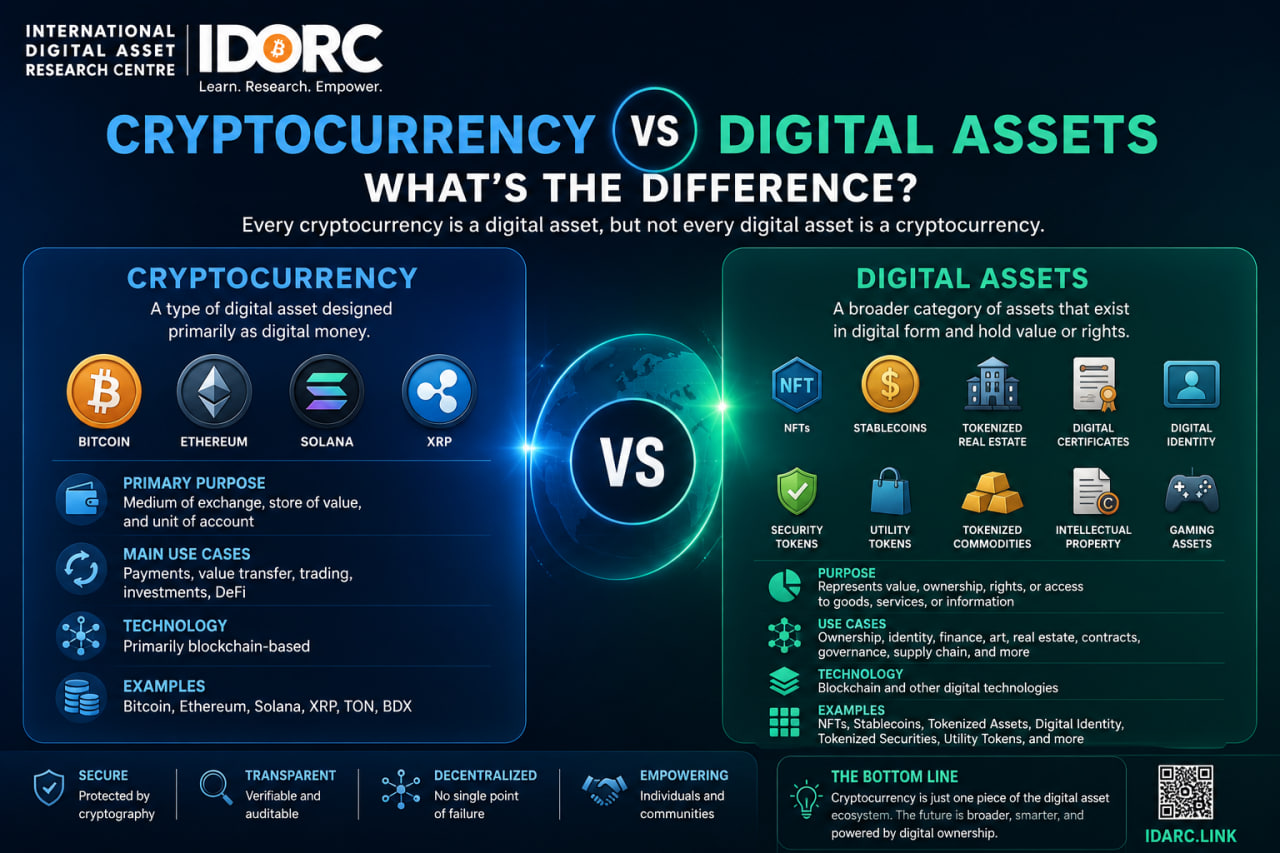
Every cryptocurrency is a digital asset, but not every digital asset is a cryptocurrency.
What is Cryptocurrency?
A cryptocurrency is a type of digital asset designed primarily to function as digital money.
Cryptocurrencies use blockchain technology and cryptographic security to facilitate secure peer-to-peer transactions without relying on central authorities.
They are commonly used for:
- Payments
- Value transfer
- Investment
- Trading
- Decentralized Finance (DeFi)
- Network governance
Popular examples include:
- Bitcoin (BTC)
- Ethereum (ETH)
- Solana (SOL)
- XRP
- TON
- Beldex (BDX)
Understanding the Relationship
Think of digital assets as a large family.
Within that family are many different categories.
One of those categories is cryptocurrency.
Just as every car is a vehicle but not every vehicle is a car, every cryptocurrency is a digital asset, but digital assets include many assets that are not cryptocurrencies.
This distinction is important because digital assets encompass a far wider range of technologies, ownership models, and business applications.
Key Differences Between Cryptocurrency and Digital Assets
| Feature | Cryptocurrency | Digital Asset |
|---|---|---|
| Purpose | Digital money | Represents any form of digital value |
| Scope | One category | Broad umbrella term |
| Technology | Primarily blockchain | Blockchain and other digital technologies |
| Primary Use | Payments and value transfer | Ownership, identity, finance, records, intellectual property, investments |
| Examples | Bitcoin, Ethereum, Solana | Cryptocurrency, NFTs, Tokenized Assets, Digital Identity, Stablecoins |
Types of Digital Assets
The digital asset ecosystem includes numerous categories.
Cryptocurrencies
Digital currencies operating on blockchain networks.
Examples include Bitcoin, Ethereum, XRP, Solana, TON, and Beldex.
Stablecoins
Digital currencies designed to maintain a relatively stable value by referencing assets such as fiat currencies.
Examples:
- USDT
- USDC
- DAI
Utility Tokens
Digital tokens that provide access to products, applications, or decentralized services.
Security Tokens
Blockchain-based representations of regulated financial instruments such as shares, bonds, and investment contracts.
Non-Fungible Tokens (NFTs)
Unique digital assets representing ownership of artwork, collectibles, music, gaming assets, event tickets, certificates, and intellectual property.
Tokenized Real-World Assets (RWAs)
Physical assets represented digitally through blockchain.
Examples include:
- Real Estate
- Gold
- Silver
- Government Bonds
- Carbon Credits
- Commodities
Digital Identity
Blockchain-based identity systems allowing individuals to securely control and verify their personal information.
Why are Cryptocurrencies Only One Part of the Digital Asset Ecosystem?
Cryptocurrencies primarily focus on transferring value.
Digital assets, however, can represent:
- Ownership
- Identity
- Intellectual property
- Contracts
- Licenses
- Academic credentials
- Real estate
- Financial securities
- Government records
- Supply chain information
As blockchain technology evolves, the number of digital asset categories continues to expand beyond traditional financial applications.
Real-World Examples
Cryptocurrency Example
Alice sends Bitcoin to Bob as payment for consulting services.
The Bitcoin functions as digital money.
Digital Asset Example
A real estate company tokenizes a commercial building into thousands of blockchain-based ownership units.
Each token represents fractional ownership of the property.
Although these tokens are digital assets, they are not cryptocurrencies.
NFT Example
An artist sells a digital painting as an NFT.
The NFT represents ownership of the artwork rather than functioning as money.
Digital Identity Example
A university issues blockchain-based academic certificates that employers can verify instantly.
The certificate is a digital asset but not a cryptocurrency.
Why the Difference Matters
Understanding the distinction between cryptocurrencies and digital assets helps individuals and organizations make informed decisions.
For Investors
Investors can diversify across different categories of digital assets rather than focusing exclusively on cryptocurrencies.
For Businesses
Organizations can adopt blockchain solutions for identity management, supply chain tracking, document verification, and asset tokenization without necessarily using cryptocurrencies.
For Governments
Governments are increasingly exploring blockchain-based digital identities, land registries, Central Bank Digital Currencies (CBDCs), and public record systems.
For Legal Professionals
Lawyers and policymakers must understand the legal classification of different digital assets because regulations often vary depending on the asset type.
Benefits of Digital Assets
Digital assets offer numerous advantages.
- Global accessibility
- Improved transparency
- Enhanced security
- Faster transactions
- Fractional ownership
- Reduced administrative costs
- Greater liquidity
- Programmable automation
- Better traceability
- Increased operational efficiency
Challenges
Despite their advantages, digital assets also present several challenges.
These include:
- Regulatory uncertainty
- Market volatility
- Cybersecurity threats
- Fraud and scams
- Technical complexity
- Custody risks
- Privacy concerns
- Legal compliance
Education and responsible adoption remain essential for reducing these risks.
The Future of Digital Assets
The future digital economy will likely be driven by far more than cryptocurrencies.
Governments and enterprises are already investing in:
- Tokenized Real-World Assets (RWAs)
- Central Bank Digital Currencies (CBDCs)
- Decentralized Identity (DID)
- Digital Securities
- Artificial Intelligence integration
- Web3 applications
- Decentralized Finance (DeFi)
- Smart Contracts
- Tokenized Intellectual Property
As adoption accelerates, digital assets are expected to become a foundational component of global commerce, finance, governance, and digital ownership.
Conclusion
Cryptocurrencies and digital assets are closely connected, but they are not identical.
A cryptocurrency is a specific type of digital asset designed primarily for transferring value and facilitating decentralized financial transactions. Digital assets, on the other hand, encompass a much broader range of digitally represented value, including identities, documents, intellectual property, tokenized securities, real-world assets, and digital ownership rights.
Recognizing this distinction provides a stronger foundation for understanding blockchain technology, Web3, tokenization, decentralized finance, and the future of the digital economy.
As digital transformation continues to reshape industries worldwide, digital literacy will require more than understanding cryptocurrencies—it will require understanding the entire digital asset ecosystem.
Key Takeaways
- Digital assets represent any form of value or ownership in digital form.
- Cryptocurrencies are one category within the broader digital asset ecosystem.
- Every cryptocurrency is a digital asset, but not every digital asset is a cryptocurrency.
- Digital assets include NFTs, stablecoins, digital identities, tokenized securities, and tokenized real-world assets.
- Understanding this distinction is essential for informed participation in the evolving digital economy.
About the International Digital Asset Research Centre (IDARC)
The International Digital Asset Research Centre (IDARC) is an independent research and educational institution dedicated to advancing awareness, research, and innovation in digital assets, blockchain technology, Web3, tokenization, decentralized finance, cybersecurity, and emerging digital ecosystems.
Through research publications, whitepaper analysis, educational initiatives, policy dialogue, and public awareness programs, IDARC empowers individuals, businesses, researchers, legal professionals, and policymakers to understand and responsibly navigate the rapidly evolving world of digital assets.
Motto: Learn. Research. Empower.
Website: https://IDARC.Link
0 Comments