What Is a Whitepaper? A Beginner’s Guide to Understanding Blockchain Whitepapers
What Is a Whitepaper? A Beginner’s Guide to Understanding Blockchain Whitepapers
Published by the International Digital Asset Research Centre (IDARC)
Introduction
Every successful blockchain project begins with an idea, but every credible blockchain project explains that idea through a whitepaper. Whether it is Bitcoin, Ethereum, Solana, Beldex, TON, or any other blockchain ecosystem, the whitepaper serves as the project’s foundational document.
For investors, developers, researchers, regulators, and technology enthusiasts, a whitepaper provides valuable insight into what a project aims to achieve, how it works, and whether it offers a genuine solution to a real-world problem.
Unfortunately, many people invest in digital assets without ever reading the project’s whitepaper. This often leads to misunderstandings, unrealistic expectations, and poor investment decisions.
Understanding how to read and evaluate a whitepaper is one of the most important skills in the digital asset ecosystem. This guide explains what a whitepaper is, why it matters, what information it contains, and how to analyze one effectively.
What Is a Whitepaper?
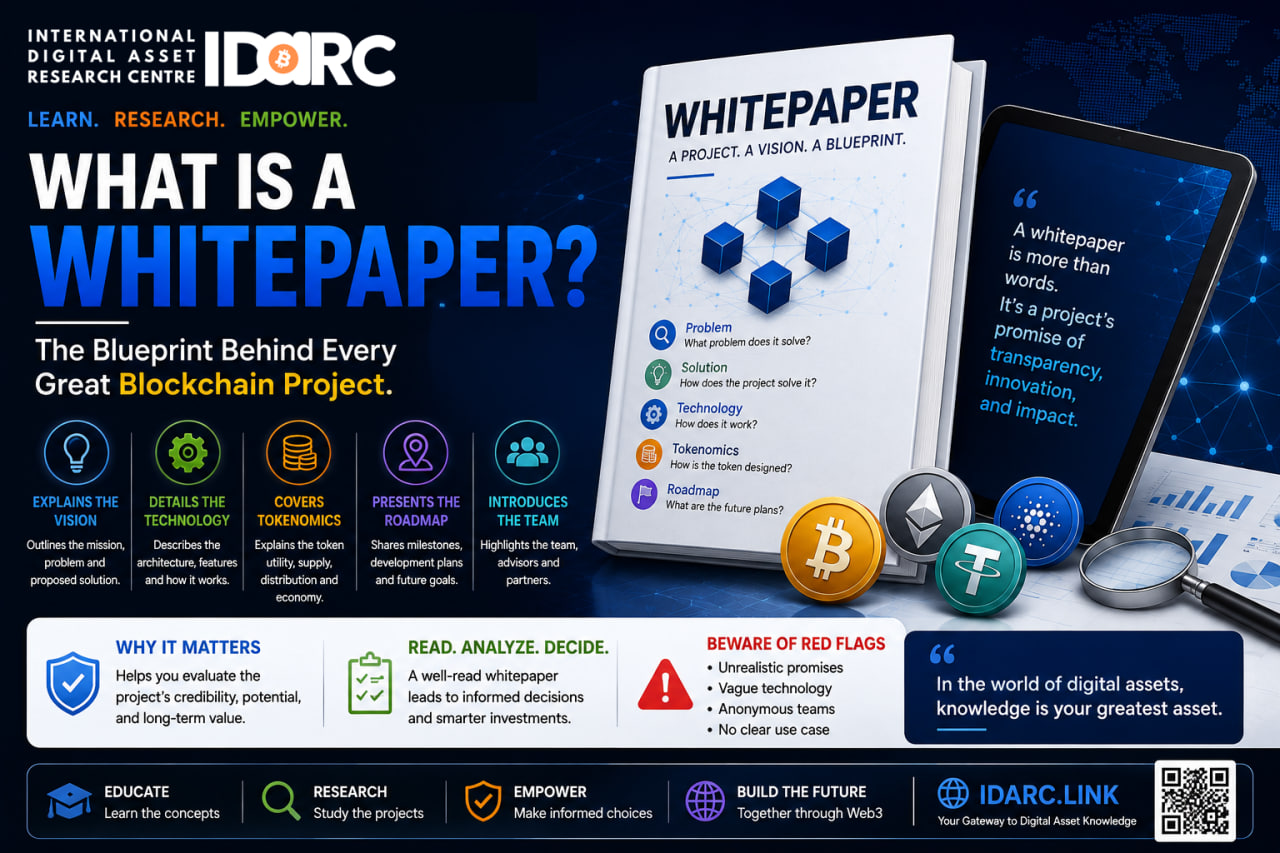
A whitepaper is an official technical and strategic document published by a blockchain project that explains its purpose, technology, business model, token economics, governance, and long-term vision.
It serves as a blueprint for the project, helping readers understand how the proposed solution works and why it has been developed.
Simply put,
A whitepaper is the official document that explains everything about a blockchain project before or during its launch.
Why Is It Called a Whitepaper?
The term whitepaper originated in government and business, where it referred to an authoritative report explaining a policy, proposal, or solution.
The blockchain industry adopted this concept because new projects needed a comprehensive document to explain complex technologies, decentralized systems, and token economies to potential users and investors.
Today, publishing a well-prepared whitepaper is considered a standard practice for serious blockchain projects.
Why Are Whitepapers Important?
Whitepapers play a critical role in the blockchain ecosystem.
Explain the Problem
Every blockchain project should clearly identify the problem it intends to solve.
Present the Solution
The whitepaper explains how blockchain technology addresses that problem.
Build Trust
Transparent documentation demonstrates professionalism and helps establish credibility.
Educate the Community
Developers, investors, researchers, and users gain a deeper understanding of the project’s objectives and technology.
Support Decision-Making
A whitepaper enables readers to evaluate whether a project aligns with their interests, research objectives, or investment strategy.
What Does a Blockchain Whitepaper Contain?
Although every project is different, most high-quality whitepapers include the following sections.
Executive Summary
A concise overview of the project’s mission and objectives.
Problem Statement
A description of the real-world challenge the project seeks to solve.
Proposed Solution
An explanation of how the project’s technology addresses the identified problem.
Blockchain Architecture
Technical details about the blockchain infrastructure, consensus mechanism, network design, and security model.
Token Utility
An explanation of how the project’s native token functions within the ecosystem.
Examples include:
- Transaction fees
- Governance
- Staking
- Rewards
- Payments
- Network security
Tokenomics
Details regarding the token economy, including:
- Total supply
- Circulating supply
- Token allocation
- Distribution model
- Vesting schedules
- Inflation or deflation mechanisms
Roadmap
The project’s development timeline, milestones, and future plans.
Team
Information about the founders, developers, advisors, and partner organizations.
Governance
How important decisions are made within the ecosystem.
Security
Information about audits, cryptographic security, network protection, and risk management.
Legal and Regulatory Considerations
Disclosures relating to applicable laws, compliance, and project limitations.
How to Read a Whitepaper
Reading a whitepaper does not require advanced technical knowledge.
A systematic approach makes the process easier.
Step 1: Understand the Problem
Ask yourself:
Does the project solve a genuine problem?
Step 2: Evaluate the Solution
Determine whether blockchain is genuinely necessary for the proposed solution.
Step 3: Study the Technology
Review the blockchain architecture, consensus mechanism, scalability, and security features.
Step 4: Analyze Tokenomics
Understand:
- Token supply
- Distribution
- Utility
- Incentive structure
Poor tokenomics often leads to unsustainable ecosystems.
Step 5: Review the Roadmap
Assess whether the project’s goals appear realistic and measurable.
Step 6: Research the Team
Evaluate the experience and credibility of the project’s leadership and development team.
Step 7: Assess Community and Ecosystem
Strong developer communities and active ecosystems often contribute to long-term project sustainability.
Characteristics of a Good Whitepaper
High-quality whitepapers generally exhibit the following characteristics.
- Clearly written
- Well-structured
- Technically accurate
- Transparent
- Evidence-based
- Realistic roadmap
- Sustainable tokenomics
- Professional presentation
- Credible team information
- Honest discussion of risks
Warning Signs
Not every whitepaper represents a legitimate project.
Be cautious if a whitepaper contains:
- Unrealistic profit promises
- Guaranteed investment returns
- Anonymous or unverifiable teams
- Vague technical explanations
- No clear use case
- Poor grammar or copied content
- Missing tokenomics
- No development roadmap
- Excessive marketing with little technical detail
A whitepaper should explain the project—not merely promote it.
Famous Blockchain Whitepapers
Several whitepapers have had a lasting impact on the blockchain industry.
Bitcoin Whitepaper
Bitcoin: A Peer-to-Peer Electronic Cash System
Published by Satoshi Nakamoto in 2008.
This document introduced decentralized digital currency and blockchain technology.
Ethereum Whitepaper
Published by Vitalik Buterin in 2013.
It introduced programmable blockchain technology and smart contracts.
Other Blockchain Projects
Many leading blockchain ecosystems—including Solana, Beldex, TON, Avalanche, Cardano, Polkadot, and numerous Web3 projects—have published whitepapers explaining their technologies and long-term vision.
Whitepaper vs Litepaper
Some blockchain projects publish both a whitepaper and a litepaper.
| Whitepaper | Litepaper |
|---|---|
| Comprehensive | Concise |
| Technical | Simplified |
| Detailed architecture | High-level overview |
| Intended for researchers and developers | Intended for general audiences |
| Extensive documentation | Marketing and introductory material |
Both documents serve different audiences but complement one another.
Why Whitepapers Matter for Investors
Before purchasing any digital asset, investors should understand:
- What problem does the project solve?
- How does the technology work?
- Is the token necessary?
- Is the team credible?
- Is the roadmap realistic?
- Does the project demonstrate long-term sustainability?
Reading the whitepaper helps reduce risk by encouraging informed decision-making rather than relying solely on market sentiment.
The Role of Whitepapers in Research
For researchers, whitepapers are valuable primary sources that provide insight into a project’s design, objectives, governance model, tokenomics, and technical architecture.
Studying multiple whitepapers also allows comparisons between different blockchain ecosystems and helps identify emerging trends and innovations.
The Future of Blockchain Whitepapers
As blockchain technology matures, whitepapers are becoming more comprehensive and transparent.
Future developments may include:
- Interactive digital whitepapers
- AI-assisted documentation
- Multilingual publications
- Real-time technical updates
- On-chain governance documentation
- Standardized disclosure frameworks
These innovations are expected to improve accessibility, accountability, and understanding across the digital asset industry.
Conclusion
A whitepaper is far more than a marketing document—it is the foundation of every serious blockchain project. It explains the project’s vision, technology, governance, tokenomics, and roadmap, enabling readers to understand how the ecosystem functions and what it seeks to achieve.
Whether you are a researcher, investor, developer, policymaker, legal professional, or blockchain enthusiast, learning to read and evaluate whitepapers is an essential skill in the digital asset ecosystem.
Before investing in any digital asset, make it a habit to read its whitepaper. A few hours of careful research can lead to better understanding, improved decision-making, and more responsible participation in the evolving digital economy.
Key Takeaways
- A whitepaper is the official document that explains a blockchain project’s vision and technology.
- It describes the problem, proposed solution, blockchain architecture, tokenomics, governance, and roadmap.
- Reading a whitepaper helps users evaluate the credibility and sustainability of a project.
- Investors should never rely solely on marketing materials before making investment decisions.
- Whitepapers are valuable resources for research, education, and understanding blockchain innovation.
About the International Digital Asset Research Centre (IDARC)
The International Digital Asset Research Centre (IDARC) is an independent research and educational institution dedicated to advancing awareness, education, and evidence-based research in digital assets, blockchain technology, Web3, decentralized finance, tokenization, cybersecurity, and emerging digital ecosystems.
Through research publications, whitepaper analysis, educational initiatives, policy dialogue, and public awareness programs, IDARC empowers researchers, professionals, legal practitioners, businesses, policymakers, and the public with trusted knowledge that supports informed participation in the rapidly evolving digital economy.
Motto: Learn. Research. Empower.
Website: https://IDARC.Link
0 Comments