What is Blockchain? Explained in Simple Language
What is Blockchain? Explained in Simple Language
Published by the International Digital Asset Research Centre (IDARC)
Introduction
Blockchain has become one of the most talked-about technologies of the digital age. While it first gained global attention as the technology behind Bitcoin, its applications now extend far beyond cryptocurrencies. Today, blockchain is transforming industries such as finance, healthcare, supply chain management, education, government services, real estate, and digital identity.
Despite its growing importance, blockchain is often misunderstood. Many people assume it is synonymous with cryptocurrency or believe it is too technical to understand. In reality, blockchain is a simple concept built on a powerful idea: creating a secure, transparent, and tamper-resistant way to record and share information.
This article explains blockchain in simple language, making it easy for beginners to understand how it works, why it matters, and how it is shaping the future of the digital economy.
What is Blockchain?
A blockchain is a decentralized digital ledger that records transactions and information securely, transparently, and chronologically.
Unlike traditional databases controlled by a single organization, blockchain stores identical copies of data across multiple computers connected through a network. Every participant has access to the same version of the ledger, making it nearly impossible for a single person or organization to alter records without the agreement of the network.
Simply put,
Blockchain is a shared digital record book where information is stored securely, verified by multiple participants, and permanently linked together in chronological order.
Understanding Blockchain Through a Simple Example
Imagine a classroom where every student has an identical notebook.
Whenever the teacher writes a new attendance record, every student updates their notebook with the same information. Before writing the next entry, everyone checks that the previous records match. If one student secretly changes yesterday’s attendance, their notebook will no longer match everyone else’s.
Blockchain works in a similar way. Instead of students, computers maintain identical copies of the ledger. Instead of manually checking records, advanced cryptographic techniques automatically verify every transaction before it becomes part of the permanent record.
Why is it Called “Blockchain”?
The technology derives its name from its structure.
Information is grouped into small collections known as blocks. Each block contains verified transactions along with a unique cryptographic reference to the previous block.
As new blocks are added, they form a continuous chain.
Because every block is connected to the previous one, changing historical information would require changing every subsequent block across thousands of computers simultaneously, making unauthorized modifications extremely difficult.
How Does Blockchain Work?
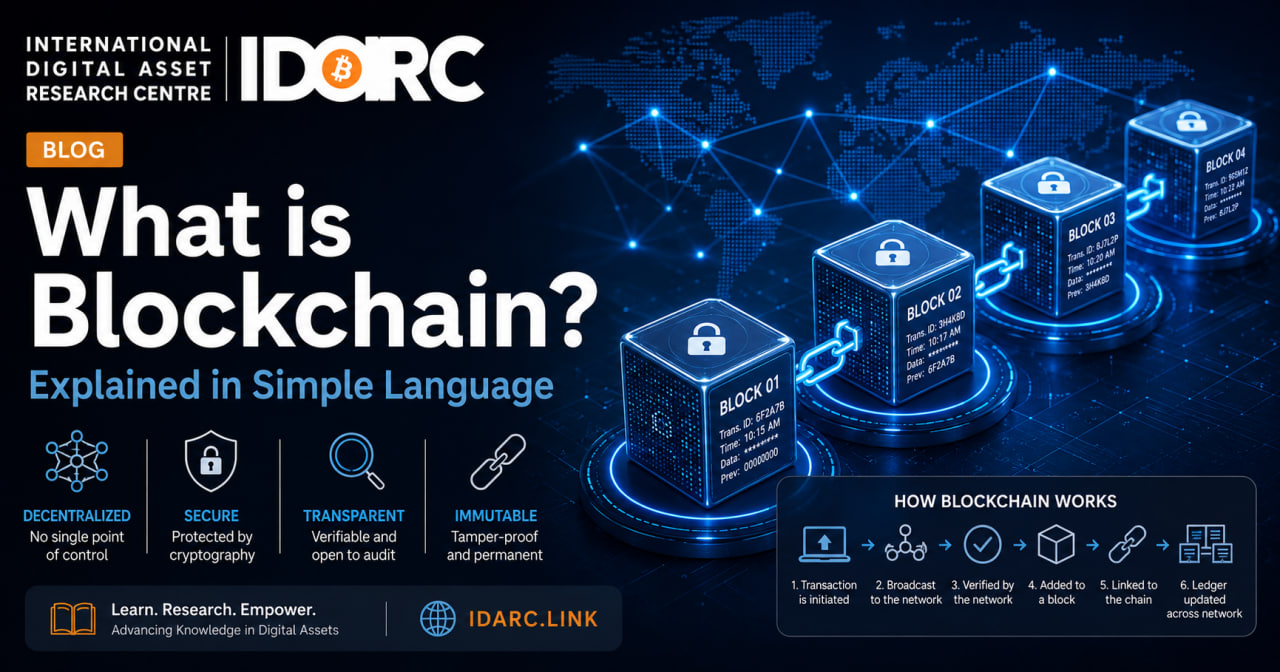
Although blockchain relies on sophisticated mathematics and cryptography, its operational process can be understood in six simple steps.
Step 1: A Transaction is Initiated
A user performs an activity, such as transferring cryptocurrency, registering ownership of a digital asset, or recording important information.
Step 2: The Request is Broadcast
The transaction is shared with computers participating in the blockchain network.
Step 3: Verification
Network participants verify the transaction by checking predefined rules such as ownership, digital signatures, available balance, and network protocols.
Step 4: Block Creation
Verified transactions are grouped together into a new block.
Step 5: The Block is Linked
The newly created block is securely connected to the previous block using cryptographic algorithms, preserving the integrity of the chain.
Step 6: Ledger Update
The updated blockchain is distributed across the network, ensuring every participant maintains the same verified copy of the ledger.
Key Characteristics of Blockchain
Decentralization
Blockchain eliminates the need for a central authority by distributing information across multiple computers. This reduces single points of failure and increases system resilience.
Transparency
Most public blockchains allow anyone to verify transactions while protecting individual identities through cryptographic addresses.
Security
Blockchain employs advanced cryptographic techniques to secure information and prevent unauthorized modifications.
Immutability
Once information is validated and recorded on the blockchain, it becomes extremely difficult to alter or delete, providing reliable and permanent records.
Traceability
Every transaction is permanently linked to previous records, creating a complete audit trail that improves accountability and transparency.
Types of Blockchain
Different organizations use different types of blockchain depending on their requirements.
Public Blockchain
Public blockchains are open to anyone wishing to participate.
Examples include Bitcoin, Ethereum, Solana, and TON.
Private Blockchain
Private blockchains restrict participation to authorized users and are commonly used within enterprises.
Consortium Blockchain
A consortium blockchain is jointly managed by multiple organizations, making it suitable for industries such as banking, logistics, and healthcare.
Hybrid Blockchain
Hybrid blockchains combine features of public and private networks, allowing organizations to determine which information remains private and which becomes publicly accessible.
Real-World Applications of Blockchain
Blockchain technology is creating value across numerous industries.
Financial Services
Banks and financial institutions use blockchain for faster cross-border payments, digital settlements, asset tokenization, and trade finance.
Healthcare
Healthcare providers utilize blockchain to secure medical records, authenticate pharmaceuticals, and improve patient identity management.
Supply Chain Management
Businesses track products throughout manufacturing and distribution, helping reduce counterfeiting while improving transparency.
Education
Universities issue blockchain-based academic certificates that can be verified instantly by employers worldwide.
Government
Governments are exploring blockchain for digital identity systems, land registration, public records, taxation, and voting solutions.
Real Estate
Property transactions become more transparent through blockchain-based ownership records and tokenized real estate investments.
Intellectual Property
Artists, musicians, writers, and creators use blockchain to protect copyrights, manage licensing, and automate royalty payments.
Advantages of Blockchain
Blockchain offers several significant benefits.
- Enhanced security through cryptography
- Increased transparency
- Improved trust among participants
- Faster transaction processing
- Lower operational costs
- Better traceability
- Reduced fraud
- Global accessibility
- Automation using smart contracts
- Greater operational efficiency
Challenges of Blockchain
Like any emerging technology, blockchain also faces certain challenges.
These include scalability limitations, regulatory uncertainty, technical complexity, integration with existing systems, cybersecurity risks outside the blockchain itself, and energy consumption in certain blockchain networks.
Ongoing research and technological innovation continue to address these challenges.
Common Misconceptions
Blockchain and Bitcoin Are the Same
Bitcoin is a cryptocurrency that operates on blockchain technology. Blockchain itself is the underlying technology that supports thousands of different applications beyond digital currencies.
Blockchain is Only for Cryptocurrency
Blockchain is increasingly being adopted in healthcare, banking, insurance, education, logistics, government, manufacturing, digital identity, and intellectual property management.
Blockchain is Anonymous
Most blockchain networks are pseudonymous rather than anonymous. Transactions remain publicly visible while users are represented by cryptographic wallet addresses instead of personal identities.
The Future of Blockchain
Blockchain is expected to become one of the foundational technologies of the digital economy.
Emerging innovations such as Central Bank Digital Currencies (CBDCs), Tokenized Real-World Assets (RWAs), Decentralized Finance (DeFi), Decentralized Identity (DID), Artificial Intelligence integration, Web3 applications, and the Internet of Things (IoT) are expanding blockchain’s capabilities beyond traditional financial systems.
As governments, businesses, educational institutions, and researchers continue to invest in blockchain solutions, the technology is expected to play a central role in creating more transparent, efficient, and trustworthy digital ecosystems.
Conclusion
Blockchain represents far more than the technology behind cryptocurrencies. It is a revolutionary method of securely recording, verifying, and sharing information without relying on centralized authorities.
Its ability to establish trust, improve transparency, strengthen security, and automate complex processes has positioned blockchain as one of the most transformative technologies of the twenty-first century.
Understanding blockchain is an essential first step for anyone seeking to explore digital assets, Web3, decentralized finance, or the rapidly evolving digital economy. As adoption continues to accelerate worldwide, blockchain literacy will become an increasingly valuable skill for individuals, businesses, legal professionals, researchers, and policymakers alike.
Key Takeaways
- Blockchain is a decentralized digital ledger.
- Information is stored in interconnected blocks protected by cryptography.
- Records are transparent, secure, and extremely difficult to modify.
- Blockchain has applications far beyond cryptocurrencies.
- Industries worldwide are adopting blockchain to improve efficiency, transparency, and trust.
- Understanding blockchain provides the foundation for learning about digital assets and the future digital economy.
About the International Digital Asset Research Centre (IDARC)
The International Digital Asset Research Centre (IDARC) is an independent research and educational institution dedicated to advancing knowledge, awareness, and innovation in digital assets, blockchain technology, Web3, tokenization, decentralized finance, cybersecurity, and emerging digital ecosystems.
Through research publications, whitepaper analysis, educational initiatives, policy dialogue, and public awareness programs, IDARC bridges the gap between technological innovation and practical understanding, empowering researchers, professionals, businesses, policymakers, and the public to navigate the evolving digital economy.
Motto: Learn. Research. Empower.
Website: https://IDARC.Link
0 Comments